
Why Long-Term Reliability Depends on More Than Just Initial Performance
Performance Is Instant, Fatigue Is Inevitable
In high-performance compute (HPC) and AI systems, most engineering efforts focus on achieving peak performance:
- Higher compute density
- Faster data throughput
- More efficient cooling
However, there is another dimension that often receives less attention:
👉 Material fatigue over time
Unlike thermal spikes or electrical failures, material fatigue develops gradually. It does not appear in initial testing—but it ultimately determines:
- System lifespan
- Maintenance frequency
- Long-term reliability
For AI infrastructure running 24/7 under heavy loads, fatigue is not a secondary concern—it is a defining factor.
What Is Material Fatigue?
Material fatigue refers to the progressive structural damage that occurs when a material is subjected to:
- Repeated mechanical stress
- Thermal cycling
- Vibrational loads
Even when stress levels are below the material’s maximum strength, repeated cycles can lead to:
- Microcrack formation
- Crack propagation
- Eventual structural failure
Why Fatigue Is Critical in AI Hardware
High-performance compute systems create a unique environment:
1. Continuous Operation
AI servers often run:
- 24 hours a day
- Under sustained high loads
This creates constant stress cycles, especially in:
- Cooling systems
- Structural supports
- Interface materials
2. Thermal Cycling
Even in “steady” workloads, temperatures fluctuate due to:
- Workload variation
- Cooling system response
- Power management
These fluctuations cause materials to expand and contract repeatedly.
👉 Over time, this leads to fatigue at interfaces and joints.
3. High Power Density
Modern GPUs generate:
- 500W to 1000W+ per unit
This results in:
- Large thermal gradients
- Localized stress concentrations
Where Fatigue Occurs in AI Systems
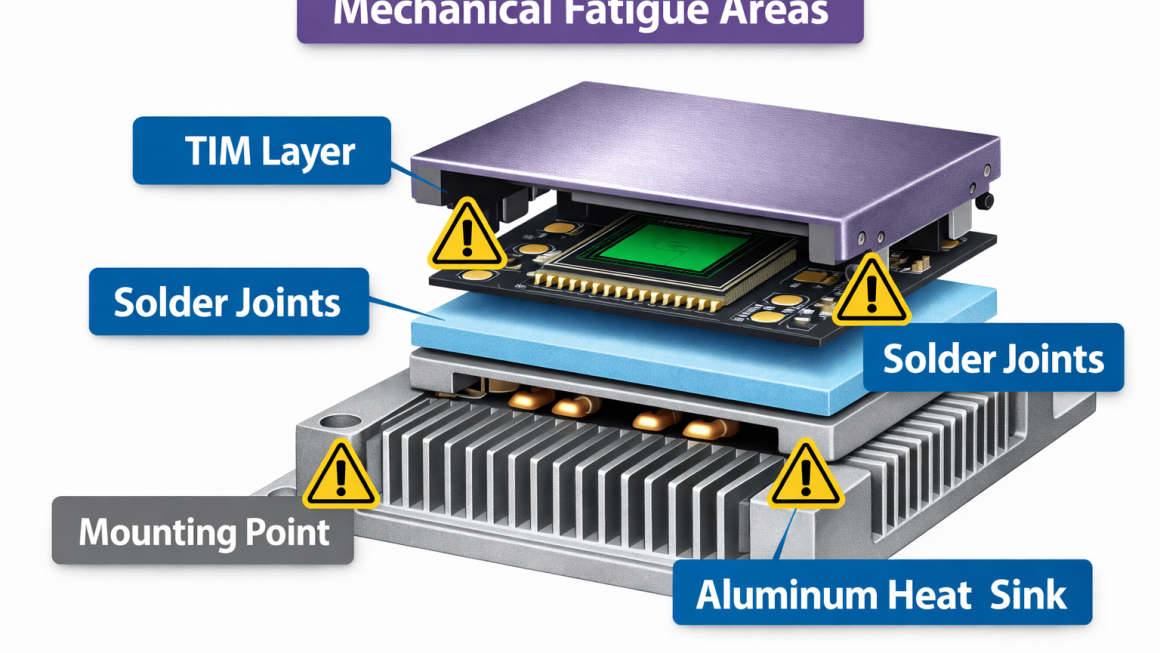
Material fatigue is not limited to one component—it appears across multiple layers.
1. Thermal Interfaces (TIM Layers)
- Pump-out and dry-out under thermal cycling
- Loss of contact quality
- Increased thermal resistance over time
2. Aluminum Structures
- Repeated expansion and contraction
- Stress at mounting points
- Potential deformation or microcracking
3. Solder Joints and Connectors
- Thermal mismatch between materials
- Crack formation in solder joints
- Intermittent electrical failures
4. Cooling System Components
- Vibration from pumps and fans
- Pressure fluctuations in liquid systems
- Fatigue in seals and joints
The Role of Material Mismatch
One of the main drivers of fatigue is:
👉 Coefficient of Thermal Expansion (CTE) mismatch
Different materials expand at different rates:
- Silicon (chip)
- Copper (interconnects)
- Aluminum (structures)
- Polymers (TIMs, adhesives)
During thermal cycling:
- Interfaces experience shear stress
- Repeated stress leads to fatigue damage
Fatigue Is an Interface Problem
A key engineering insight:
Fatigue rarely starts in the bulk material—it starts at interfaces.
Critical interfaces include:
- Chip ↔ TIM ↔ heat spreader
- GPU ↔ cold plate
- Board ↔ connector
- Structure ↔ mounting points
These areas experience:
- Stress concentration
- Movement constraints
- Material mismatch
Design Strategies to Mitigate Fatigue
1. Material Compatibility
- Select materials with closer CTE values
- Reduce mismatch-driven stress
2. Mechanical Compliance
- Use flexible or compliant layers (e.g., certain TIMs)
- Allow controlled movement between components
3. Optimized Mounting Design
- Even pressure distribution
- Avoid localized stress points
4. Thermal Management Stability
- Reduce temperature fluctuations
- Improve cooling consistency
5. Surface Engineering
- Improve contact quality
- Reduce micro-gaps that amplify stress
Aluminum’s Role in Fatigue Management
Aluminum is widely used in AI systems, but its behavior under fatigue must be understood.
Advantages:
- Good thermal conductivity
- Lightweight
- Reasonable fatigue resistance
Challenges:
- Sensitive to cyclic stress at joints
- Requires proper design to avoid stress concentration
👉 Aluminum performance depends heavily on:
- Geometry design
- Mounting strategy
- Interface integration
The Trade-Off: Performance vs Longevity
A common engineering tension:
- Designs optimized for peak performance
- vs
- Designs optimized for long-term reliability
For example:
- Higher clamping force improves thermal contact
- But increases mechanical stress and fatigue risk
Aluminum4AI Perspective: Designing for Time, Not Just Performance
At aluminum4ai.com, fatigue is approached as a system-level reliability issue, not just a material property.
1. Focus on Interfaces
- Understanding how materials interact over time
- Identifying stress concentration points
2. Supporting R&D Validation
- Prototype-level fatigue considerations
- Early-stage design adjustments
3. Bridging Thermal and Mechanical Design
Fatigue sits at the intersection of:
- Thermal cycling
- Mechanical stress
- Material behavior
Future Trends in Fatigue-Aware Design
1. Simulation-Driven Reliability
- Predict fatigue behavior before deployment
- Reduce trial-and-error in design
2. Advanced Interface Materials
- More stable TIMs
- Improved adhesion and compliance
3. Integrated Structural Design
- Structures designed to absorb stress
- Reduced reliance on rigid connections
4. Long-Life Data Center Design
As AI infrastructure becomes more critical:
- Systems will be designed for longer lifespans
- Fatigue will become a primary design parameter
Reliability Is Built Over Time
In high-performance compute systems:
- Performance is immediate
- But reliability is cumulative
Material fatigue represents:
👉 The slow, invisible process that determines system longevity
Understanding fatigue requires:
- Looking beyond materials
- Focusing on interfaces
- Designing for real-world operation
For aluminum4ai.com, this reinforces a core principle:
👉 The goal is not just to enable performance—but to support systems that last.