


Why Structure Matters in AI Infrastructure
As AI data centers evolve toward:
- Higher rack densities
- Larger GPU clusters
- Advanced liquid cooling systems
- Modular deployment architectures
the importance of structural engineering is growing rapidly.
At the center of this transformation is one material:
👉 Aluminum
Once viewed mainly as a lightweight industrial metal, aluminum is now becoming a critical enabling material for next-generation AI infrastructure.
Its combination of:
- Lightweight strength
- Thermal performance
- Corrosion resistance
- Scalability
makes it highly suitable for modern AI data center environments.
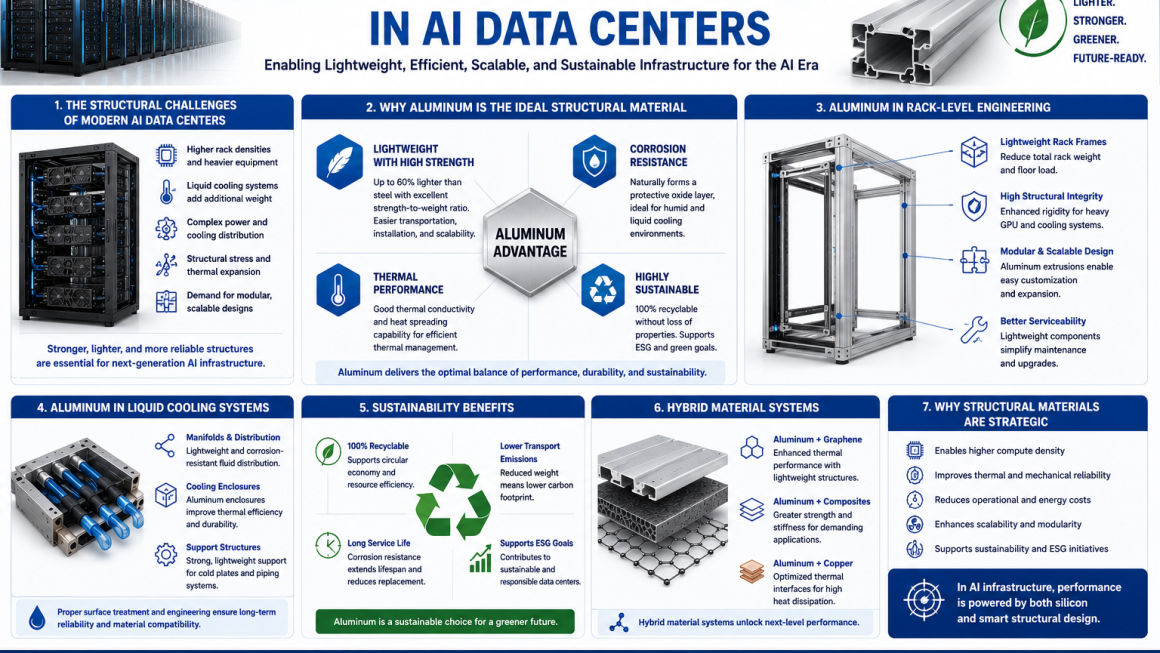
1. The Structural Challenges of Modern AI Data Centers
AI infrastructure is becoming physically heavier and more complex.
Modern racks may include:
- Multiple high-power GPUs
- Cold plates and liquid cooling systems
- Manifolds and coolant distribution hardware
- High-capacity power systems
This creates major structural demands:
- Increased rack loading
- Mechanical stress
- Weight distribution challenges
- Thermal expansion concerns
👉 Traditional designs optimized for lighter server loads are no longer sufficient.
2. Why Aluminum Is Gaining Importance
Aluminum offers a unique balance of properties that align with modern AI infrastructure needs.
Lightweight with High Strength
Compared with steel:
- Aluminum significantly reduces structural weight
- Easier transportation and deployment
- Lower rack stress and installation burden
This becomes especially important in:
- High-density GPU systems
- Edge AI deployments
- Modular containerized data centers
Corrosion Resistance
AI cooling systems increasingly involve:
- Liquid cooling
- Humidity-controlled environments
- Long-term thermal cycling
Aluminum naturally forms a protective oxide layer, helping improve:
- Durability
- Reliability
- Maintenance performance
👉 Particularly valuable in liquid cooling environments.
Thermal Performance
Although not as conductive as copper, aluminum still offers:
- Good thermal conductivity
- Excellent heat spreading capability
- Lightweight thermal structures
Applications include:
- Heat sinks
- Chassis structures
- Cooling enclosures
- Thermal support components
3. Structural Aluminum in Rack-Level Engineering
Modern AI racks require precise structural optimization.
Aluminum enables:
- Lightweight rack frames
- Reinforced modular structures
- Improved weight distribution
- Easier scalability and maintenance
Benefits at rack level:
- Reduced total rack mass
- Better seismic and vibration behavior
- Improved serviceability
👉 Structural engineering is increasingly tied to thermal and operational efficiency.
4. Aluminum in Liquid Cooling Systems
As AI cooling shifts toward liquid-based systems, aluminum plays multiple roles.
Applications include:
- Manifold structures
- Cooling enclosures
- Support frames for cold plates
- Fluid distribution hardware
Advantages:
- Lightweight fluid infrastructure
- Reduced system weight
- Easier modular integration
Material Compatibility Considerations
Because liquid cooling systems involve:
- Water-glycol mixtures
- Dielectric fluids
- Thermal cycling
proper engineering is critical to avoid:
- Galvanic corrosion
- Surface degradation
- Long-term reliability issues
This drives demand for:
- Surface treatments
- Anodization
- Hybrid material systems
5. Aluminum and Sustainability
Sustainability is becoming a major priority in AI infrastructure.
Aluminum contributes through:
High Recyclability
- Aluminum can be recycled repeatedly with low material loss
- Supports circular manufacturing strategies
Weight Reduction
- Lower transportation emissions
- Reduced structural load in facilities
Long Service Life
- Corrosion resistance improves durability
- Reduced replacement frequency
👉 Structural aluminum aligns strongly with future ESG and sustainability goals.
6. Hybrid Material Systems: Aluminum + Advanced Materials
Future AI infrastructure will likely combine aluminum with:
- Graphene coatings
- Carbon composites
- Copper thermal interfaces
Examples:
- Aluminum structures with graphene-enhanced thermal surfaces
- Aluminum-composite hybrid chassis
- Lightweight cooling modules with advanced coatings
👉 Aluminum becomes the foundational structural platform within advanced hybrid systems.
7. Why Structural Materials Are Becoming Strategic
Historically, AI discussions focused on semiconductors.
But today:
- Weight affects deployment scalability
- Thermal performance affects compute density
- Structural reliability affects uptime
- Material efficiency affects sustainability
👉 Structural materials are becoming strategic assets in AI infrastructure design.
Companies increasingly need:
- Lightweight engineering
- Thermal-mechanical optimization
- Modular scalable systems
And aluminum sits at the center of this transition.
Aluminum Is Becoming a Core Material for AI Infrastructure
The future of AI data centers depends not only on processing power—but also on how infrastructure is physically designed and supported.
Structural aluminum offers:
- Lightweight strength
- Good thermal behavior
- Corrosion resistance
- Scalability and sustainability advantages
👉 As AI infrastructure grows more dense, modular, and thermally demanding, structural aluminum will play an increasingly important role in enabling reliable and efficient next-generation systems.