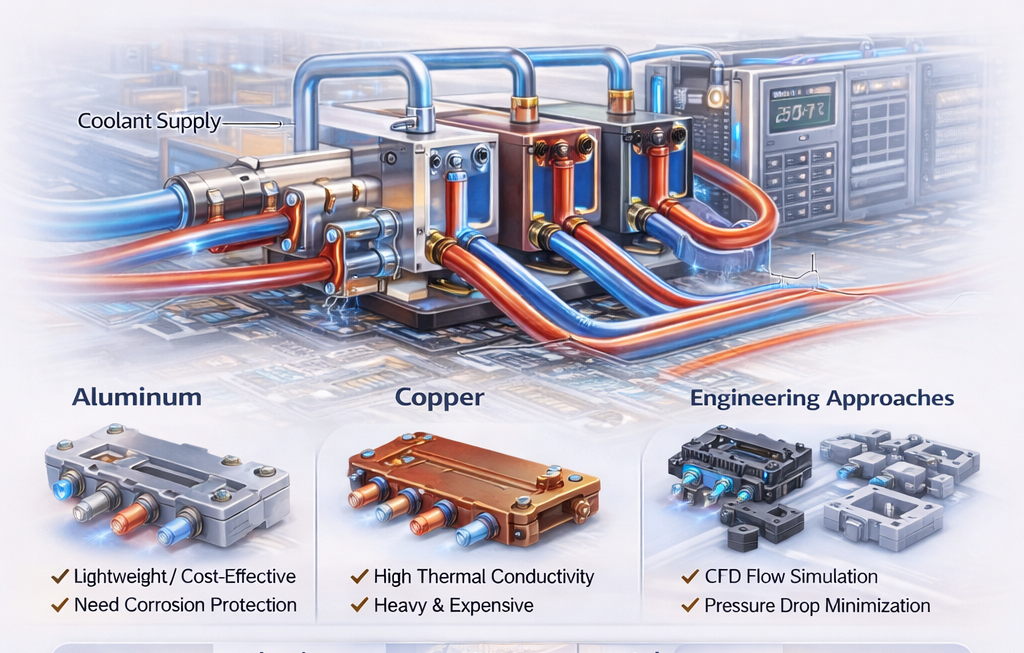
The Role of Manifolds in Liquid Cooling Systems
In liquid cooling architectures—especially Direct-to-Chip (D2C) systems—most attention is given to cold plates and coolants.
However, one critical component often overlooked is the manifold.
👉 A liquid cooling manifold acts as the distribution hub, ensuring that coolant is delivered evenly and efficiently across multiple processors or servers.
In high-density AI infrastructure, manifold design directly impacts:
- Flow balance
- Cooling efficiency
- System reliability
- Scalability
1. What Is a Liquid Cooling Manifold?
A manifold is a fluid distribution structure that:
- Splits incoming coolant into multiple channels
- Delivers it to cold plates or components
- Collects and returns heated fluid
Core functions:
- Uniform coolant distribution
- Flow control across parallel circuits
- Pressure stabilization
- System integration across racks or nodes
👉 In AI systems with multiple GPUs, flow imbalance can lead to uneven cooling and performance loss.
2. Engineering Challenges in Manifold Design
Flow Distribution Uniformity
- Ensuring equal flow to each cold plate
- Avoiding “hot nodes” due to uneven cooling
Pressure Drop Management
- Complex channel geometries increase resistance
- Must balance flow rate and pump efficiency
Scaling Across Systems
- From single server → full rack → data center
- Maintaining performance consistency at scale
Compact Integration
- Limited space in server racks
- Need for high-density fluid routing
👉 Poor manifold design can negate the benefits of advanced cold plates and coolants.
3. Materials Used in Liquid Cooling Manifolds
Material selection is critical for both performance and reliability.
Aluminum (Al)
Advantages:
- Lightweight
- Cost-effective
- Easy to machine or extrude
Considerations:
- Requires corrosion protection (anodization, coatings)
- Compatibility with coolant must be controlled
👉 Ideal for scalable AI infrastructure and large-volume production
Copper (Cu)
Advantages:
- Excellent thermal conductivity
- High durability
Considerations:
- Heavy and expensive
- Less common for large manifolds due to cost
👉 Used in high-performance or specialized systems
Engineering Polymers
Advantages:
- Corrosion-resistant
- Lightweight
- Electrically insulating
Considerations:
- Lower mechanical strength
- Limited temperature tolerance
👉 Suitable for low-pressure or modular designs
Hybrid Structures
- Metal core (Al or Cu) + polymer interfaces
- Coatings or liners for corrosion resistance
👉 Increasingly used to balance performance, cost, and durability
4. Advanced Engineering Approaches
Optimized Channel Design
- Computational Fluid Dynamics (CFD) used for flow simulation
- Ensures uniform distribution and minimal pressure drop
Modular Manifold Systems
- Standardized interfaces for scalability
- Easier maintenance and replacement
Additive Manufacturing
- Enables complex internal geometries
- Improves flow efficiency and compactness
Surface Engineering
- Anti-corrosion coatings
- Reduced friction for improved flow
5. Reliability and Leak Prevention in Manifolds
Manifolds are central nodes in the system—any failure has system-wide impact.
Key considerations:
- High-quality sealing at connection points
- Material compatibility with coolant
- Structural integrity under pressure and thermal cycling
Design strategies:
- Reduce unnecessary joints
- Use robust connectors and seals
- Implement leak detection and monitoring
6. Why Manifolds Matter in AI Infrastructure
In high-density AI systems:
- Multiple GPUs share a cooling loop
- Flow imbalance leads to uneven temperatures
- System reliability depends on centralized distribution
👉 A well-designed manifold ensures:
- Consistent cooling across all nodes
- Improved system efficiency
- Scalable infrastructure deployment
Manifolds Are the Backbone of Liquid Cooling Systems
While cold plates handle heat at the chip level, manifolds manage how cooling is delivered across the entire system.
The best-performing AI cooling systems combine:
- Optimized manifold design
- Proper material selection
- Advanced manufacturing techniques
- Integrated system engineering
👉 In next-generation AI infrastructure, manifold design is not just a component choice—it is a system-level engineering decision.