Cooling Is Not Just About Flow—It’s About Chemistry
In liquid cooling systems, most discussions focus on flow rate, cold plates, and thermal performance.
However, one critical factor is often underestimated:
👉 Coolant material and system compatibility
In high-density AI infrastructure, improper coolant selection can lead to:
- Corrosion
- Material degradation
- Blockage and fouling
- System failure
At scale, this is not just a technical issue—it’s a reliability and cost risk.
1. Types of Coolants Used in Liquid Cooling
Water-Based Coolants (Most Common)
Characteristics:
- Excellent thermal capacity
- High heat transfer efficiency
- Cost-effective
Challenges:
- Electrical conductivity risk
- Corrosion potential
- Requires additives (inhibitors, biocides)
👉 Widely used in Direct-to-Chip (D2C) systems
Dielectric Fluids (Advanced Systems)
Characteristics:
- Electrically non-conductive
- Safe for immersion cooling
- Stable under high temperatures
Challenges:
- Higher cost
- Lower thermal conductivity than water
- Fluid management complexity
👉 Used in immersion cooling and high-reliability environments
Glycol Mixtures (Water + Glycol)
Characteristics:
- Anti-freezing capability
- Improved stability in varying environments
Challenges:
- Reduced thermal performance vs pure water
- Viscosity impacts flow efficiency
👉 Common in outdoor or variable temperature systems
2. Material Compatibility: The Hidden Risk


4
A cooling system is a multi-material environment:
- Copper
- Aluminum
- Stainless steel
- Polymers (seals, tubing)
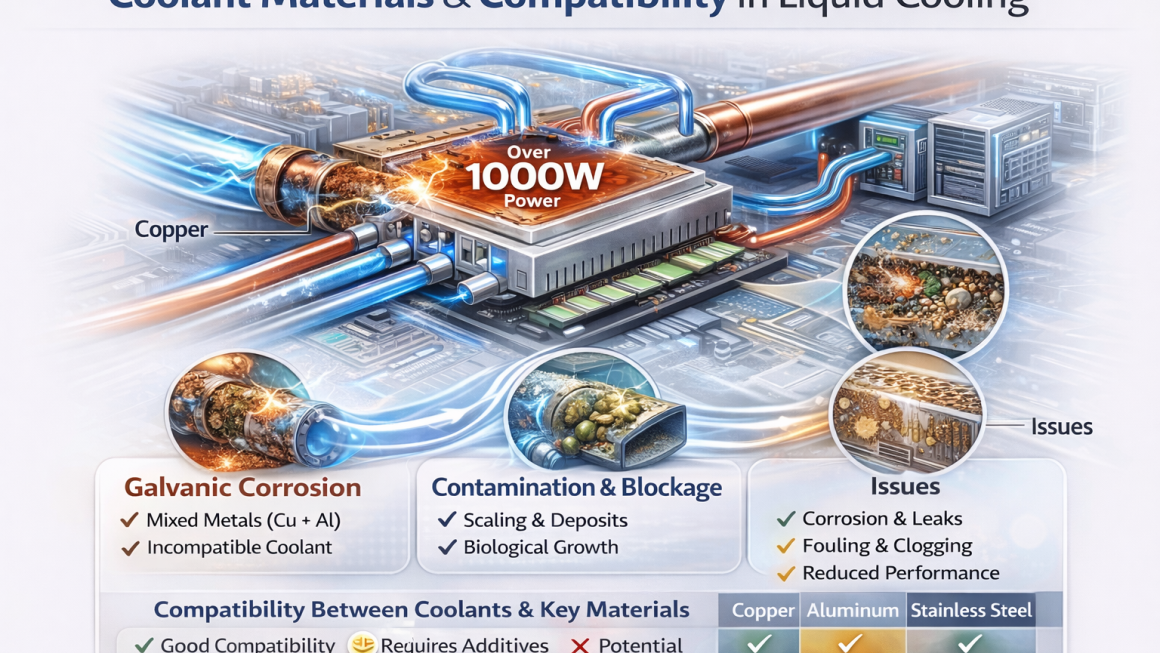
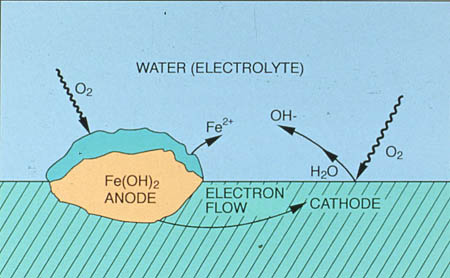
When these materials interact with coolant, electrochemical reactions can occur.
Key Risks:
Galvanic Corrosion
- Occurs when different metals (e.g., Cu + Al) are connected via conductive coolant
- Leads to rapid material degradation
Oxidation and Scaling
- Mineral deposits reduce heat transfer efficiency
- Microchannels are especially vulnerable
Biological Growth
- Bacteria or algae formation in water-based systems
- Causes blockage and fouling
3. Compatibility Between Coolant and Key Materials
| Material | Compatibility Considerations |
|---|---|
| Copper | Good thermal performance, requires corrosion inhibitors |
| Aluminum | Sensitive to pH and corrosion, needs protective coatings |
| Stainless Steel | High corrosion resistance, higher cost |
| Polymers | Must resist swelling, degradation, and permeation |
👉 System design must consider the entire material ecosystem—not individual components.
4. Role of Additives and Fluid Engineering
To ensure compatibility, coolants are rarely used in pure form. They include:
- Corrosion inhibitors → protect metals
- Biocides → prevent microbial growth
- pH stabilizers → maintain chemical balance
- Anti-scaling agents → reduce deposits
Proper fluid formulation ensures:
- Long system lifetime
- Stable thermal performance
- Reduced maintenance frequency
5. Design Strategies for Compatibility
Material Matching
- Avoid direct Cu–Al combinations without protection
- Use coatings or isolation layers
Closed-Loop Systems
- Minimize contamination and exposure to air
Surface Engineering
- Anodization (for aluminum)
- Anti-corrosion coatings
- Advanced materials (graphene-based barriers)
Monitoring and Maintenance
- Regular coolant analysis (pH, conductivity)
- Filtration systems
- Scheduled replacement cycles
6. Why This Matters for AI Infrastructure
In AI data centers:
- Systems run continuously at high load
- Downtime is extremely expensive
- Maintenance windows are limited
👉 A small compatibility issue can escalate into:
- Reduced cooling efficiency
- Hardware failure
- System shutdown
Compatibility Is a System-Level Decision
Liquid cooling success is not only about thermal performance—it is about long-term stability and reliability.
The most effective systems integrate:
- Proper coolant selection
- Material compatibility design
- Advanced coatings and materials
- Ongoing monitoring
👉 In next-generation AI infrastructure, coolant chemistry and material science are as important as cooling architecture itself.