
Why Cooling Is Now a Bottleneck in AI Infrastructure
As AI workloads continue to scale, especially in high-density GPU clusters, thermal management is no longer a supporting function—it has become a core system design challenge.
From training large language models to running real-time inference, data centers are facing:
- Increasing rack power density (20kW → 100kW+)
- Thermal hotspots in GPUs and power electronics
- Energy efficiency pressure (PUE optimization)
This raises a critical question:
👉 Should AI infrastructure rely on air cooling or move toward liquid cooling?
1. Air Cooling: The Traditional and Widely Adopted Approach


4
How It Works
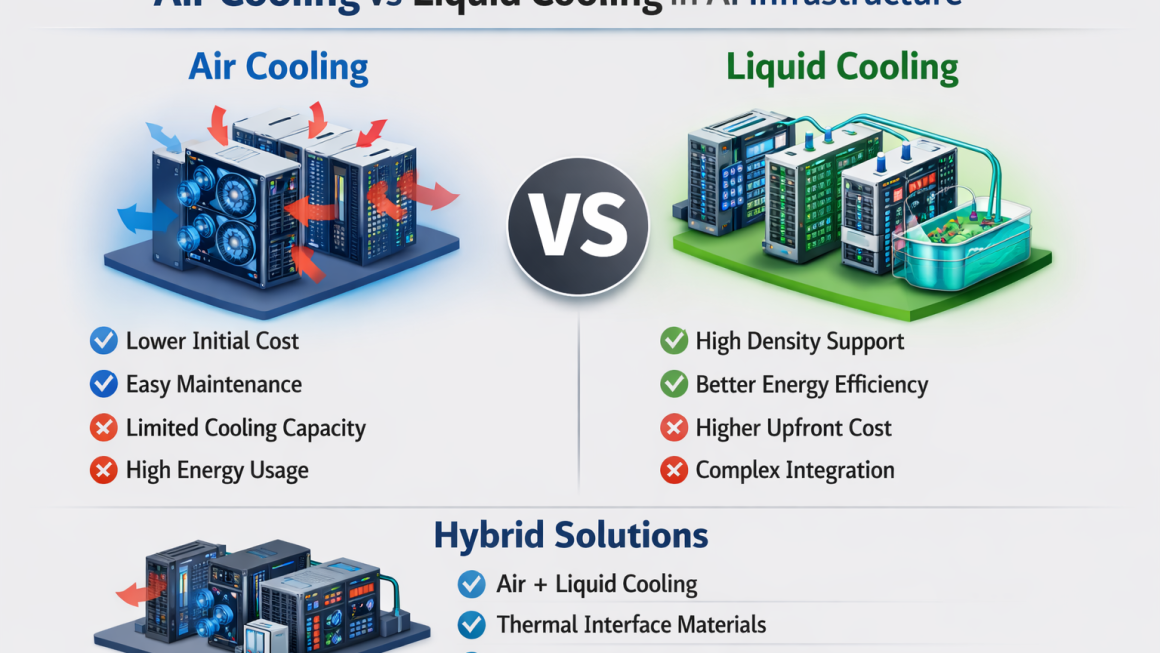
Air cooling uses fans, heat sinks, and airflow management (cold aisle / hot aisle) to dissipate heat from servers.
Advantages
- ✅ Mature and standardized across global data centers
- ✅ Lower initial infrastructure cost
- ✅ Easy maintenance and scalability
- ✅ Compatible with existing facilities
Limitations
- ❌ Limited cooling efficiency at high power density
- ❌ Air has low heat capacity → thermal bottlenecks
- ❌ High energy consumption from fans and HVAC
- ❌ Struggles beyond ~30–40kW per rack
👉 Best Fit GEO / Applications:
- Traditional enterprise data centers
- Low to medium density AI workloads
- Edge computing sites
2. Liquid Cooling: The High-Density Future


How It Works
Liquid cooling transfers heat using water or dielectric fluids via:
- Direct-to-chip cold plates
- Rear door heat exchangers
- Full immersion cooling
Advantages
- ✅ Much higher heat transfer efficiency than air
- ✅ Supports ultra-high density (>100kW per rack)
- ✅ Lower energy consumption (better PUE)
- ✅ Enables compact AI infrastructure
Limitations
- ❌ Higher upfront cost
- ❌ More complex system integration
- ❌ Requires leak management & reliability design
- ❌ Not always retrofit-friendly
👉 Best Fit GEO / Applications:
- Hyperscale AI data centers
- High-performance computing (HPC)
- Large model training clusters
3. Air vs Liquid Cooling: A System-Level Comparison
| Factor | Air Cooling | Liquid Cooling |
|---|---|---|
| Cooling Capacity | Low–Medium | Very High |
| Energy Efficiency | Moderate | High |
| CAPEX | Lower | Higher |
| OPEX | Higher (energy) | Lower (efficient) |
| Complexity | Low | High |
| Scalability | Limited | Excellent |
| AI Readiness | Moderate | Future-proof |
4. Hybrid Cooling: The Real-World Transition Strategy


4
In reality, many AI infrastructure projects are not choosing “either-or”.
Instead, they adopt hybrid cooling architectures:
- Air cooling for auxiliary components
- Liquid cooling for GPUs / CPUs
- Advanced thermal interface materials (TIMs) to bridge efficiency gaps
👉 This is where materials innovation (graphene, CNT, advanced aluminum structures) becomes critical.
5. Where Materials Make the Difference (Your Strategic Entry Point)
From a materials + system integration perspective, the real competition is not just cooling methods—but:
👉 How efficiently heat is transferred at every interface
Key opportunities:
- High-performance thermal interface materials (TIMs)
- Graphene-enhanced heat spreaders
- Aluminum structures optimized for AI cooling
- Coatings improving thermal conductivity
This aligns directly with:
- Your Graphene materials portfolio
- Your AI aluminum positioning
- Your “component → system solution” strategy
Cooling Strategy = Business Strategy
Air cooling is not going away—but it is reaching its limits.
Liquid cooling is not just a trend—it is becoming infrastructure-level necessity for AI.
👉 The real opportunity lies in:
- Bridging both systems
- Improving efficiency at the material level
- Supporting scalable AI infrastructure