
Understanding the Trade-Offs in Thermal Management for Modern Compute Systems
Cooling Is Now a Design Constraint
As AI infrastructure continues to scale, cooling is no longer a background function—it has become a primary design constraint.
The choice between:
- Air cooling
- Liquid cooling
is no longer just about preference. It directly affects:
- System performance
- Energy efficiency
- Hardware lifespan
- Infrastructure design
The key question is no longer “Which is better?”
But rather: “Which is appropriate under specific conditions?”
Air Cooling: Simplicity and Maturity
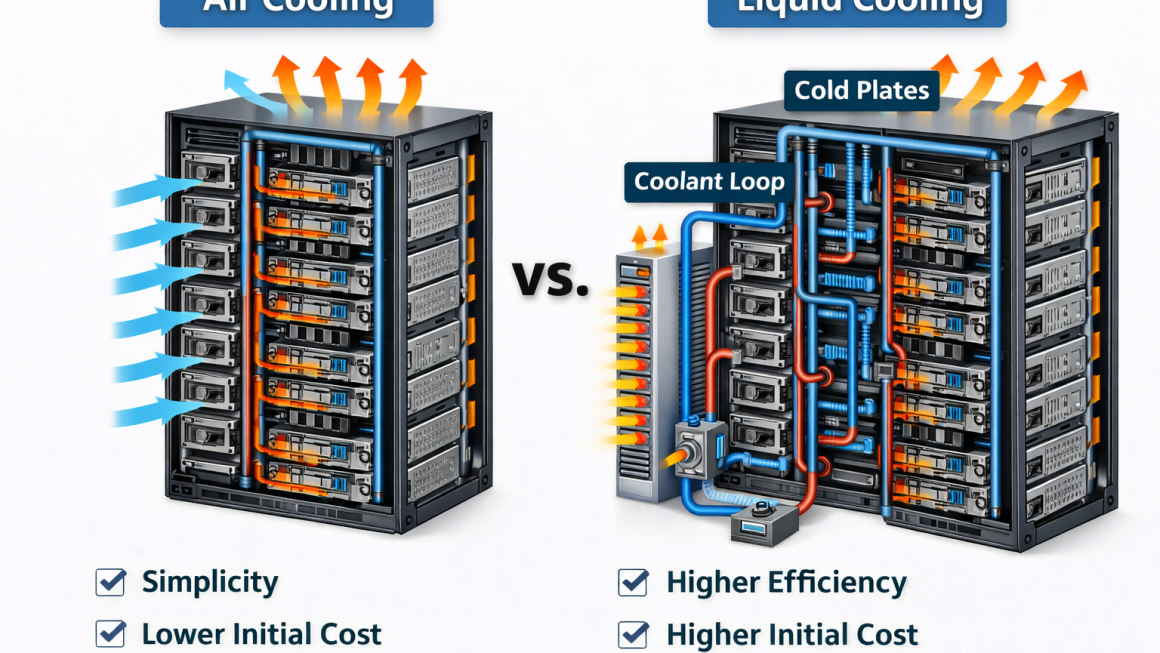
Air cooling remains the most widely used method in data centers.
How It Works
- Fans move air across components
- Heat is transferred from surfaces to airflow
- Hot air is removed from the system
Advantages
1. Simplicity
- No fluid handling
- Fewer system components
- Easier integration
2. Lower Initial Cost
- No pumps or piping
- Standardized infrastructure
3. Easier Maintenance
- Minimal risk of leakage
- Familiar to most operators
Limitations
1. Thermal Capacity Constraints
Air has:
- Low heat capacity
- Limited thermal conductivity
👉 Difficult to manage very high heat flux
2. Airflow Dependency
Cooling effectiveness depends on:
- Airflow design
- Rack layout
- Ambient conditions
3. Hotspot Risk
In dense systems:
- Air cannot evenly reach all components
- Local overheating becomes more likely
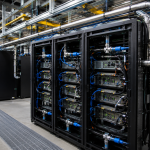
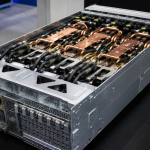
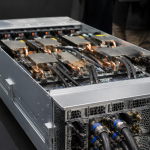
Liquid Cooling: Efficiency and Scalability
Liquid cooling is increasingly adopted for high-performance AI systems.
How It Works
- Coolant absorbs heat directly from components
- Heat is transported via fluid loops
- Heat is dissipated through exchangers
Advantages
1. Superior Heat Transfer
Liquids offer:
- Higher heat capacity
- Better thermal conductivity
👉 Enables efficient removal of high heat loads
2. Higher Compute Density
- Supports tightly packed systems
- Reduces reliance on airflow spacing
3. Thermal Stability
- More consistent temperature control
- Reduced thermal cycling
Challenges
1. System Complexity
- Pumps, pipes, seals
- Integration challenges
2. Higher Upfront Cost
- Infrastructure investment
- Design complexity
3. Reliability Considerations
- Leak risk
- Material compatibility
- Long-term sealing performance
The Core Differences
1. Heat Transport Mechanism
- Air cooling → convective airflow
- Liquid cooling → fluid-based heat transfer
2. Cooling Efficiency
- Air → limited at high density
- Liquid → scalable with power density
3. System Design Impact
- Air → requires space for airflow
- Liquid → requires integration of fluid systems
4. Energy Consumption
- Air → high fan energy at scale
- Liquid → lower cooling energy but higher system complexity
When Air Cooling Still Makes Sense
Air cooling remains effective under certain conditions:
- Moderate power density
- Lower rack density
- Cost-sensitive deployments
- Simpler infrastructure requirements
When Liquid Cooling Becomes Necessary
Liquid cooling becomes more suitable when:
- Power density exceeds airflow capability
- Thermal hotspots cannot be controlled
- Rack density is very high
- Energy efficiency becomes critical
Hybrid Systems: A Practical Middle Ground
Many modern AI data centers adopt hybrid approaches:
- Liquid cooling for high-power components (e.g., GPUs)
- Air cooling for less critical areas
This approach:
- Balances performance and cost
- Reduces system complexity
- Enables gradual transition
Impact on Materials and Interfaces
Cooling choice affects not only temperature—but also material behavior.
In Air Cooling Systems
- Greater temperature gradients
- Higher thermal cycling
- Increased stress at interfaces
In Liquid Cooling Systems
- More stable temperatures
- Higher demands on:
- TIM performance
- Surface flatness
- Structural precision
Key Insight
Cooling technology changes how materials age over time.
Aluminum4AI Perspective: Beyond Cooling Methods
At aluminum4ai.com, the focus is not on choosing one method over the other.
Instead, the emphasis is on:
👉 Understanding how each cooling approach affects:
- Material behavior
- Interface stability
- Structural performance
Key Considerations
- Thermal path design
- Interface quality over time
- Mechanical stress under different cooling conditions
Future Outlook
1. Increasing Adoption of Liquid Cooling
- Driven by AI workloads
- Especially in high-density systems
2. Continued Role of Air Cooling
- In edge computing
- In lower-density deployments
3. More Integrated Design Approaches
- Thermal + mechanical + material co-design
- System-level optimization
Choosing Based on Reality, Not Trend
The transition from air to liquid cooling is not absolute—it is conditional.
Air cooling remains:
- Practical
- Reliable
- Cost-effective
Liquid cooling offers:
- Higher performance ceiling
- Better thermal control
- Scalability for future workloads
The right choice depends on system requirements, not technological preference.
For aluminum4ai.com, the key takeaway is:
👉 Cooling is not just about removing heat—it is about how materials, interfaces, and structures behave under continuous operation.