As artificial intelligence workloads continue to expand, the physical infrastructure supporting AI computing is undergoing a fundamental transformation. High-density GPU servers, accelerated computing platforms, liquid cooling systems, high-capacity power distribution, and increasingly compact rack architectures are creating new requirements for data center infrastructure.
In this environment, infrastructure can no longer be designed by considering structural materials, thermal management, and mechanical systems as completely independent components. The performance of an AI data center increasingly depends on how materials, cooling systems, structural components, rack architecture, and mechanical interfaces are integrated at the system level.
This shift has created a new engineering concept: system-level architecture for AI physical infrastructure.
Rather than asking which aluminum alloy, cooling plate, rack profile, or structural component should be selected individually, engineers must consider how these components work together throughout the complete infrastructure architecture.
What Is System-Level Architecture in AI Physical Infrastructure?
System-level architecture refers to the coordinated design of the physical infrastructure that supports AI computing equipment.
At a simplified level, an AI data center infrastructure can be viewed as several interconnected layers:
AI Computing → Server → Rack → Cooling → Structural System → Facility Infrastructure
Each layer introduces different mechanical, thermal, electrical, and environmental requirements.
For example, a high-density AI rack may contain multiple GPU servers generating substantial heat. That heat must be transferred efficiently from semiconductor devices to cold plates, coolant loops, heat exchangers, and eventually the facility cooling infrastructure.
At the same time, the rack must support heavy computing equipment, withstand installation and transportation loads, maintain dimensional stability, accommodate cable routing, and provide reliable interfaces for liquid cooling connections.
Consequently, a material or component that performs well in isolation may not necessarily provide the best solution at the system level.
The objective is therefore to optimize the complete infrastructure architecture rather than individual components.
Why AI Infrastructure Requires a Different Architecture
Traditional data centers were largely designed around relatively moderate rack power densities and air cooling.
AI infrastructure is different.
Modern accelerated computing platforms can generate significantly higher thermal loads within a relatively small physical footprint. This creates a chain reaction across the infrastructure.
Higher computing density leads to higher heat generation.
Higher heat generation increases cooling requirements.
Higher cooling requirements increase the weight and complexity of cooling equipment.
Higher equipment weight increases structural requirements.
More complex cooling and structural systems require tighter mechanical tolerances and more sophisticated interfaces.
This means thermal design and mechanical design increasingly influence each other.
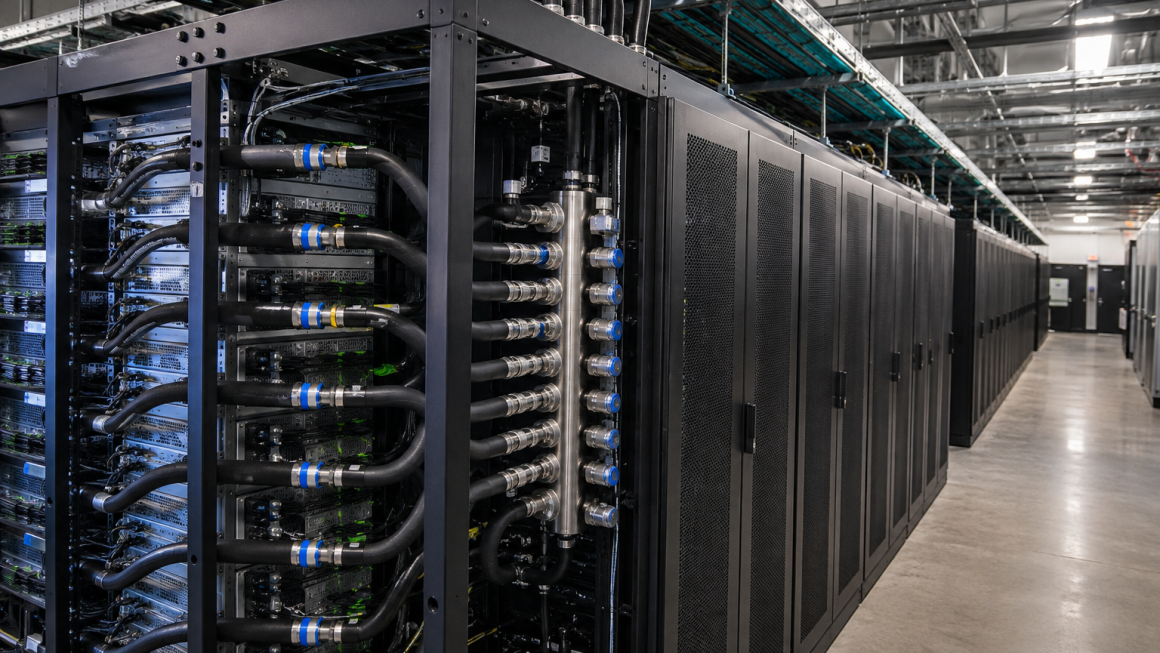
For example, a liquid-cooled AI rack may require coolant manifolds, quick-disconnect interfaces, cold plates, pipes, pumps, valves, and heat exchangers. These components occupy physical space and introduce additional loads into the rack structure.
Therefore, the rack cannot simply be designed first and cooling added afterward.
The cooling architecture and structural architecture need to evolve together.
Materials as the Foundation of AI Physical Infrastructure
Materials play a fundamental role in determining the performance, weight, reliability, and manufacturability of AI infrastructure.
Among structural materials, aluminum alloys are increasingly attractive because they combine relatively low density, good thermal conductivity, corrosion resistance, machinability, and extrusion capability.
For AI data center applications, aluminum can be used in:
- Rack frames
- Structural beams
- Equipment mounting profiles
- Liquid cooling channels
- Cold plates
- Heat sinks
- Thermal management components
- Cable management structures
- Lightweight support systems
Aluminum extrusion is particularly useful because complex cross-sectional geometries can be manufactured efficiently.
A single aluminum profile can incorporate structural reinforcement, mounting interfaces, cable-routing channels, cooling channels, and fastening features.
This creates an important opportunity for functional integration.
Instead of treating each function as a separate component, engineers can potentially integrate multiple functions into one optimized structural profile.
Structural Aluminum for High-Density AI Racks
AI racks are becoming more demanding from a mechanical perspective.
A rack may need to support servers, GPUs, power distribution equipment, cooling manifolds, piping, cables, and other auxiliary systems.
The structural system therefore needs sufficient stiffness and load-bearing capability while maintaining dimensional accuracy.
Aluminum extrusion profiles can provide several advantages in this environment.
First, the geometry can be optimized according to the expected load distribution.
Second, internal ribs and reinforced sections can improve stiffness without unnecessarily increasing material volume.
Third, modular extrusion systems can simplify assembly and maintenance.
Fourth, aluminum’s relatively low density can reduce the weight of large structural assemblies.
This becomes increasingly important when AI infrastructure needs to be installed, transported, modified, or upgraded.
The ideal structural architecture is therefore not simply the strongest possible structure. It should achieve a balance between:
Strength + Stiffness + Weight + Manufacturability + Thermal Performance + Serviceability
Cooling and Structure Must Be Designed Together
One of the most important characteristics of AI physical infrastructure is the close relationship between cooling and structural design.
Liquid cooling systems introduce components that traditional air-cooled racks may not require.
These include:
- Coolant distribution units
- Manifolds
- Pipes
- Quick-disconnect couplings
- Cold plates
- Heat exchangers
- Pumps
- Valves
- Sensors
- Leak detection systems
Each component requires space and mechanical support.
The cooling system also introduces additional weight and potential vibration or mechanical loads.
At the same time, coolant flow paths must be carefully positioned to minimize pressure loss and maintain consistent thermal performance.
This means structural profiles may need to accommodate cooling interfaces directly.
For example, an aluminum structural channel could be designed with dedicated mounting points for manifolds or integrated channels for thermal management components.
This type of integration can reduce component count and simplify assembly.
Thermal Management Is a System Problem
Thermal performance in an AI data center cannot be evaluated only by looking at the thermal conductivity of an individual material.
A high-conductivity material does not automatically produce an efficient cooling system.
Actual thermal performance depends on the complete heat-transfer path:
GPU → Thermal Interface → Cold Plate → Coolant → Manifold → Distribution System → Heat Exchanger → Facility Cooling
Every interface introduces thermal resistance.
Every pipe introduces hydraulic resistance.
Every structural component affects available space and mechanical constraints.
Therefore, AI infrastructure engineers need to evaluate the complete thermal path rather than focusing on one material property.
This is particularly important for high-density computing environments where even small increases in thermal resistance can affect cooling capacity and operating efficiency.
Aluminum as Both Structural and Thermal Material
One of the most interesting opportunities in AI infrastructure is the ability of aluminum to serve both structural and thermal functions.
Traditional infrastructure design often separates these functions.
A steel structure may provide mechanical support, while a separate copper or aluminum thermal component handles heat transfer.
However, aluminum extrusion and advanced machining technologies can enable more integrated designs.
For example, an aluminum profile may simultaneously provide:
Mechanical Support + Mounting Interface + Thermal Path + Cable Routing
This multifunctional architecture can reduce the number of separate components and potentially simplify manufacturing.
In large-scale AI infrastructure, component reduction can have significant benefits because fewer components can mean fewer assembly operations, fewer interfaces, and fewer potential failure points.
Cooling Channel Integration
The development of integrated cooling channels represents another important direction.
Instead of installing separate cooling pipes around a structural system, engineers can investigate whether certain channels or manifolds can be incorporated into aluminum structural components.
Such an approach requires careful consideration of:
- Coolant compatibility
- Pressure resistance
- Sealing performance
- Corrosion resistance
- Manufacturing tolerances
- Cleaning requirements
- Leak detection
- Maintenance access
The challenge is not simply creating a cooling channel.
The real challenge is creating a cooling structure that remains reliable throughout the operating lifetime of the AI infrastructure.
This is why material selection, extrusion design, machining, surface treatment, sealing technology, and quality control need to be considered together.
Mechanical Interfaces Are Becoming Critical
As AI infrastructure becomes more modular, mechanical interfaces become increasingly important.
A modern AI rack may need to connect servers, cooling systems, power systems, monitoring equipment, and facility infrastructure.
These interfaces must maintain dimensional compatibility while allowing installation and maintenance.
Important interface technologies may include:
- Quick-disconnect cooling couplings
- Modular mounting rails
- Extruded aluminum profiles
- Precision-machined brackets
- Adjustable structural connections
- Cable management interfaces
- Thermal interface components
Standardized interfaces can significantly improve scalability.
For data center operators, this means equipment can potentially be replaced or upgraded without redesigning the entire physical infrastructure.
Design for Maintenance and Retrofit
AI infrastructure is evolving rapidly.
A rack designed for today’s accelerator hardware may need to accommodate a different server architecture in the future.
This creates a strong requirement for modularity.
A good AI infrastructure architecture should therefore consider not only initial installation but also:
Installation → Operation → Maintenance → Upgrade → Retrofit
Modular aluminum structures are particularly suitable for this approach because profiles and mechanical interfaces can be configured for different equipment arrangements.
Cooling systems should also provide sufficient flexibility for future changes.
For example, modular manifolds and standardized quick-disconnect interfaces can make it easier to replace servers or modify cooling loops without reconstructing the complete rack.
Manufacturing Considerations
System-level architecture must ultimately be translated into manufacturable components.
This requires coordination between engineering design and manufacturing processes.
For aluminum infrastructure, common manufacturing stages may include:
Aluminum Billet → Extrusion → Cutting → CNC Machining → Surface Treatment → Assembly → Inspection
Each stage can influence final system performance.
Extrusion tolerances affect assembly accuracy.
Machining accuracy affects interface alignment.
Surface treatment affects corrosion resistance and appearance.
Assembly quality affects structural integrity and sealing performance.
Therefore, manufacturing capability should be considered during the initial design stage rather than after the architecture has been finalized.
From Component Optimization to Infrastructure Optimization
The future of AI physical infrastructure is moving from component-level optimization toward system-level optimization.
Instead of asking:
“Which material has the highest thermal conductivity?”
Engineers may increasingly ask:
“How can the material, structural geometry, cooling architecture, and manufacturing process work together to provide the most efficient infrastructure?”
Similarly, instead of asking:
“How can we make a stronger rack?”
The more relevant question becomes:
“How can we create a lightweight rack that integrates structural support, cooling interfaces, cable management, service access, and future scalability?”
This represents a fundamental change in engineering thinking.
The Role of Digital Engineering
Digital engineering can accelerate this transition.
Computational tools can be used to evaluate structural deformation, thermal distribution, airflow, coolant flow, pressure drop, vibration, and mechanical interfaces before physical prototypes are manufactured.
Finite element analysis can help evaluate structural performance.
Computational fluid dynamics can help analyze coolant and air flow.
Thermal simulation can identify potential hotspots.
Digital manufacturing models can help evaluate extrusion and machining feasibility.
By combining these tools, engineers can create a more integrated virtual model of the AI physical infrastructure.
This approach can reduce development cycles and identify potential problems before large-scale manufacturing begins.
Toward Integrated AI Infrastructure Platforms
The long-term direction is likely to move toward integrated infrastructure platforms rather than isolated products.
An AI data center supplier may provide not only an aluminum profile, cooling component, or structural bracket, but an integrated solution combining:
Material Selection + Structural Design + Thermal Management + Mechanical Interfaces + Manufacturing + Surface Treatment
This creates new opportunities for specialized suppliers that understand both materials and system architecture.
For aluminum manufacturers, this means the competitive advantage may increasingly come from engineering capability rather than extrusion capacity alone.
For cooling suppliers, it means understanding rack architecture and mechanical integration may become just as important as thermal performance.
For infrastructure developers, it means selecting suppliers based on their ability to participate in system-level engineering rather than simply supplying individual components.
The physical infrastructure supporting AI computing is entering a new stage of development.
Higher rack power density, liquid cooling adoption, heavier equipment, tighter mechanical tolerances, and rapid hardware evolution are making traditional component-by-component design increasingly insufficient.
The future of AI data center infrastructure will depend on the integration of materials, cooling, structural systems, mechanical interfaces, and manufacturing processes.
Aluminum is particularly well positioned within this architecture because it can combine lightweight structural performance, thermal conductivity, corrosion resistance, and highly configurable extrusion geometries.
However, the real value does not come from aluminum alone.
The opportunity lies in designing aluminum structures, cooling channels, thermal components, and mechanical interfaces as parts of a unified system.
For AI infrastructure manufacturers and data center developers, the next competitive advantage may therefore come from system-level integration rather than individual component optimization.
As AI computing density continues to increase, the ability to connect material science, thermal engineering, structural design, and manufacturing into one physical infrastructure architecture will become increasingly important.
AI Infrastructure → Materials → Structure → Cooling → Integration → Reliability
This integrated architecture provides a foundation for building the next generation of high-density AI data centers.