AI data centers are evolving into highly integrated engineering systems where computing performance, thermal management, power delivery, and mechanical structure must work together under increasingly demanding conditions. While processors and cooling technologies often receive the most attention, the mechanical structure of the system plays a foundational role in ensuring stability, serviceability, and long-term operational reliability.
Aluminum structural systems are widely used in AI data center infrastructure due to their balance of mechanical strength, relatively low weight, manufacturability, and compatibility with thermal management designs. These systems include server chassis, rack structures, mounting frames, heat spreader supports, and modular enclosure components.
Mechanical design is not simply a supporting function; it directly influences thermal performance, system density, maintenance efficiency, and scalability of AI infrastructure.
This article examines why aluminum structural systems are important in AI data centers and how mechanical design affects overall system performance.
The Role of Mechanical Systems in AI Data Centers
AI data centers are not only electrical or computational systems—they are physical systems composed of tightly integrated mechanical and thermal structures.
Key mechanical responsibilities include:
- Supporting high-density computing hardware
- Maintaining precise alignment of electronic components
- Enabling airflow or liquid cooling pathways
- Managing vibration and mechanical stress
- Supporting cable routing and service access
- Ensuring structural stability in rack-level assemblies
As computing power increases, mechanical systems must handle higher heat loads, greater weight density, and more complex integration requirements.
Why Aluminum Is Widely Used in Structural Systems
Aluminum alloys are commonly selected for AI infrastructure mechanical components due to several engineering characteristics.
1. Balanced Strength-to-Weight Ratio
Aluminum provides sufficient mechanical strength for many structural applications while maintaining relatively low density. This is particularly important in:
- Server chassis
- Modular rack components
- Movable or serviceable assemblies
Reduced weight can also improve installation efficiency and reduce mechanical load on supporting structures.
2. Thermal Conductivity Contribution
Although aluminum is primarily a structural material, it also has moderate thermal conductivity compared to other structural metals.
In AI systems, aluminum components can contribute to:
- Heat spreading across structural surfaces
- Thermal coupling between components
- Integration with cold plate or heat sink systems
This dual mechanical-thermal role is increasingly important in high-power-density AI servers.
3. Manufacturing Compatibility
Aluminum is compatible with multiple industrial manufacturing methods, including:
- CNC machining
- Extrusion forming
- Die casting
- Sheet metal fabrication
This flexibility allows engineers to design complex geometries while maintaining scalable production processes.
4. Corrosion Resistance and Stability
Aluminum naturally forms an oxide layer that provides protection against corrosion. With additional surface treatments such as anodizing or coating, durability can be further improved for long-term deployment in controlled data center environments.
Mechanical Design as a System-Level Function
In AI data centers, mechanical design is no longer isolated from thermal or electrical engineering. Instead, it is part of a unified system design approach.
Structural-Thermal Coupling
Mechanical structures often interact directly with cooling systems.
Examples include:
- Aluminum frames acting as heat conduction paths
- Structural integration with liquid cooling cold plates
- Mounting systems designed to minimize thermal resistance
This coupling requires careful consideration of both mechanical rigidity and thermal behavior.
High-Density Integration Requirements
Modern AI servers contain:
- Multiple GPUs or accelerators
- High-power CPUs
- Dense memory configurations
- Complex power distribution systems
Mechanical structures must support tight packaging while maintaining accessibility for maintenance and upgrades.
Vibration and Mechanical Stress Control
Data centers may experience:
- Continuous operation loads
- Rack-level vibration
- Thermal expansion cycles
Aluminum structures must be designed to maintain dimensional stability and prevent mechanical misalignment over time.
Aluminum Structures in Key Data Center Components
Server Chassis
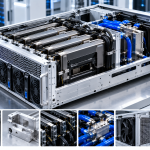
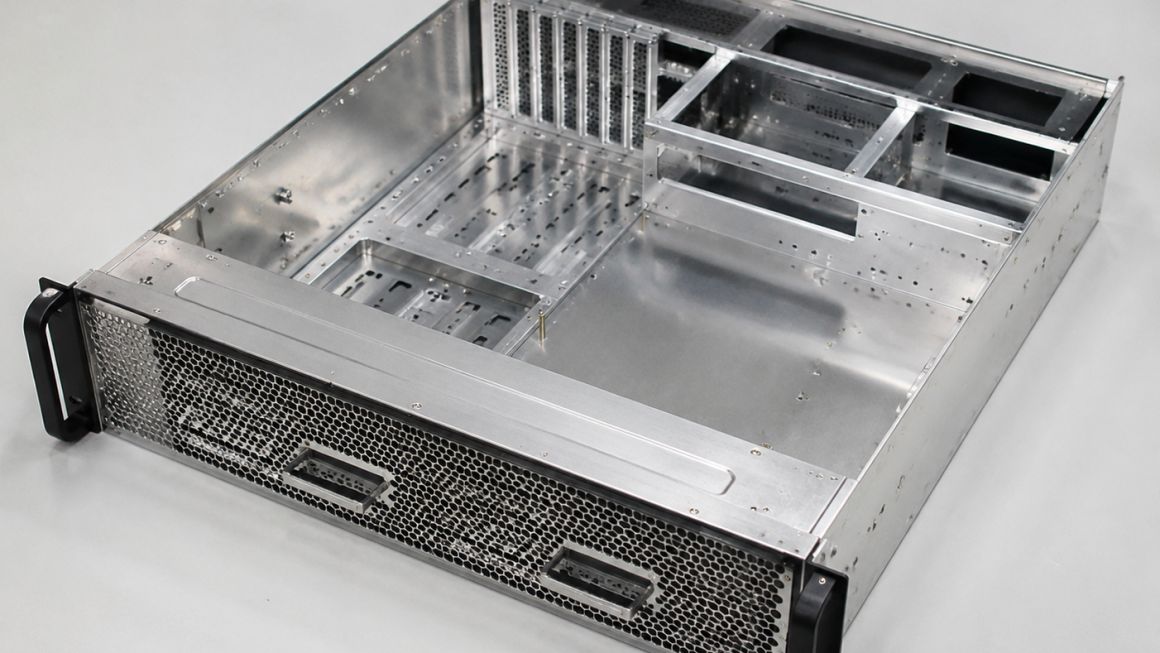
Aluminum is commonly used in server chassis due to its lightweight nature and ease of fabrication. Design considerations include:
- Component mounting precision
- Airflow or liquid cooling integration
- Structural rigidity under high density
Rack Systems
AI racks must support significant weight from compute nodes and cooling equipment. Aluminum is often used in:
- Modular rack frames
- Side panels
- Mounting rails
In some cases, hybrid aluminum-steel systems are used depending on load requirements.
Liquid Cooling Integration Frames
As liquid cooling becomes more common in AI infrastructure, aluminum structural components are increasingly used to support:
- Cold plate assemblies
- Manifold systems
- Fluid routing structures
Mechanical precision is critical to ensure sealing reliability and thermal performance.
Cable Management Structures
Aluminum is also used in:
- Cable trays
- Routing channels
- Support brackets
These components must balance mechanical strength with accessibility and airflow optimization.
Manufacturing Considerations for Aluminum Structural Systems
Mechanical performance is closely linked to manufacturing methods.
Precision Machining
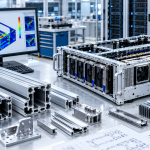
CNC machining is often used for high-precision aluminum components in AI systems, particularly where tight tolerances are required.
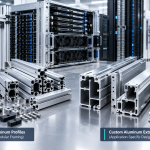
Extrusion Profiles
Extruded aluminum profiles are widely used for:
- Rack systems
- Modular structures
- Standardized support components
Surface Treatment
Surface engineering improves performance and durability through:
- Anodizing
- Protective coatings
- Anti-corrosion treatments
Design Challenges in AI Data Center Structures
Increasing Power Density
Higher computing density leads to:
- Greater structural load
- Increased thermal coupling requirements
- More complex integration constraints
Multi-System Integration
Mechanical systems must coordinate with:
- Thermal systems
- Electrical distribution
- Data connectivity
- Serviceability requirements
Manufacturing Scalability
Designs must be suitable for both:
- Prototype production
- Scaled industrial manufacturing
This often requires balancing customization with standardization.
Future Trends in Aluminum Structural Systems
Hybrid Material Structures
Future designs may combine aluminum with:
- Composite materials
- Engineering polymers
- Thermally conductive fillers
This enables optimization of weight, strength, and thermal behavior.
Integrated Thermal-Structural Design
Mechanical systems are increasingly designed to function as part of thermal management systems rather than separate components.
Modular Infrastructure Design
Standardized modular aluminum structures may support faster deployment and easier system upgrades in AI data centers.
Digital Engineering Integration
Simulation tools such as:
- Finite element analysis (FEA)
- Thermal modeling
- Digital twin systems
are increasingly used to optimize mechanical design before manufacturing.
Aluminum structural systems play a critical role in AI data centers by providing mechanical support, enabling thermal integration, and supporting high-density computing architectures. As AI infrastructure continues to evolve, mechanical design is becoming more closely integrated with thermal and electrical system engineering.
Rather than serving as passive support structures, aluminum components increasingly function as active elements within system-level performance design. Their role spans from server chassis and rack systems to liquid cooling integration and cable management infrastructure.
As computing density increases and system complexity grows, mechanical design will remain a foundational discipline in the development of reliable, scalable, and efficient AI data center infrastructure.