Liquid Cooling Is More Than a Thermal System
As AI infrastructure evolves toward:
- Higher GPU density
- 1000W+ accelerators
- Rack-scale liquid cooling
- Ultra-dense compute environments
liquid cooling is rapidly becoming a core requirement for next-generation AI systems.
However, successful liquid cooling implementation depends on more than thermal efficiency alone.
👉 Structural compatibility has become equally important.
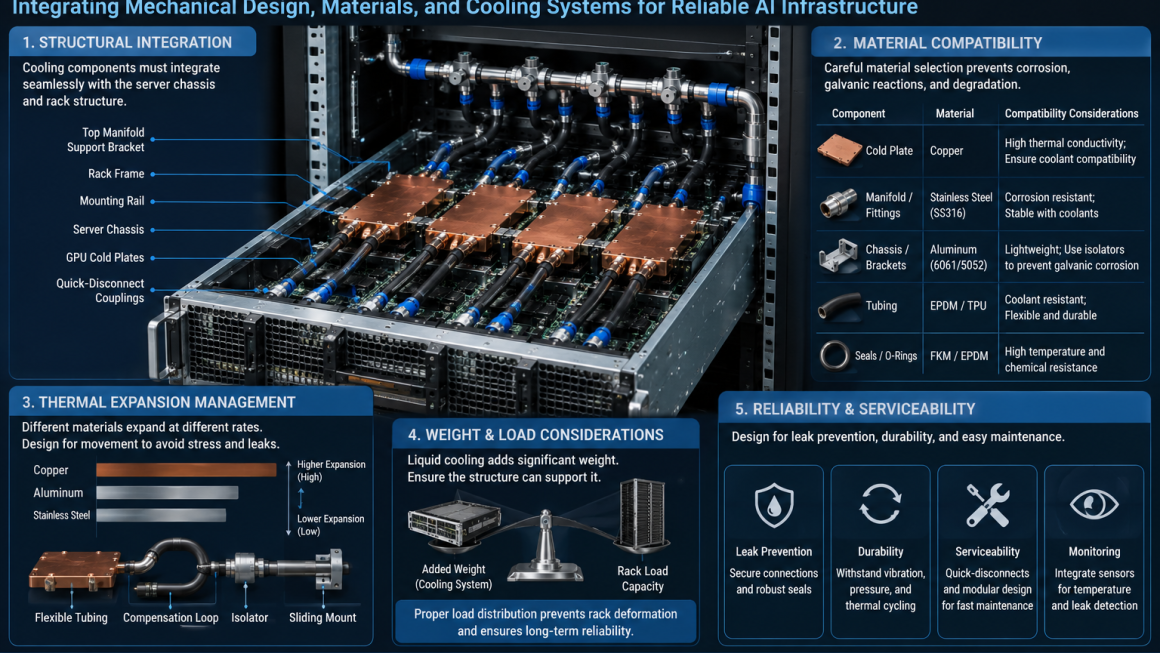
Modern liquid cooling architectures must integrate:
- Mechanical structures
- Fluid systems
- Thermal components
- Material compatibility
- Long-term reliability engineering
Without proper structural compatibility, even advanced cooling systems can face:
- Leakage risks
- Mechanical stress
- Thermal instability
- Maintenance challenges
- Reduced infrastructure lifespan
1. What Is Structural Compatibility in Liquid Cooling?
Structural compatibility refers to how effectively cooling systems integrate with:
- Server chassis
- Rack structures
- Cooling manifolds
- Mounting systems
- Fluid routing architectures
This includes compatibility across:
- Mechanical load distribution
- Material behavior
- Thermal expansion
- Vibration resistance
- Serviceability requirements
👉 Liquid cooling systems must function as part of an integrated infrastructure platform—not as isolated thermal devices.
2. Why AI Infrastructure Creates Structural Challenges
Modern AI servers are dramatically different from traditional IT hardware.
They include:
- Multiple high-power GPUs
- Heavy cold plate assemblies
- Coolant distribution hardware
- Dense power systems
This creates:
- Higher structural loading
- Increased mechanical stress
- Complex thermal-mechanical interactions
At rack scale:
- Weight concentration becomes significant
- Fluid routing complexity increases
- Structural reliability becomes critical
👉 AI infrastructure pushes both cooling and structural systems to new limits.
3. Thermal Expansion and Mechanical Stress
Liquid cooling systems operate under continuous thermal cycling.
Components repeatedly experience:
- Heating
- Cooling
- Pressure fluctuation
Different materials expand at different rates.
For example:
- Aluminum
- Copper
- Stainless steel
- Polymers
all behave differently under thermal load.
Without proper structural compatibility:
- Seal failure may occur
- Mounting pressure may shift
- Cold plate contact quality may degrade
👉 Thermal-mechanical design is essential for long-term reliability.
4. Material Compatibility in Liquid Cooling Systems
Liquid cooling systems require careful material selection.
Key concerns include:
- Corrosion resistance
- Galvanic interaction
- Chemical compatibility with coolant fluids
Aluminum
Advantages:
- Lightweight
- Good thermal properties
- Scalable manufacturing
Challenges:
- Requires corrosion management in mixed-metal systems
Copper
Advantages:
- Excellent thermal conductivity
Challenges:
- Higher weight
- Potential galvanic interaction with aluminum
Polymers and Elastomers
Used for:
- Tubing
- Seals
- Connectors
Must withstand:
- Thermal cycling
- Fluid exposure
- Long operational lifetimes
👉 Structural compatibility depends heavily on material interaction management.
5. Structural Integration of Cold Plates and Manifolds
Modern liquid cooling architectures require precise mechanical integration.
Cold Plate Mounting
Challenges include:
- Uniform contact pressure
- GPU package protection
- Thermal interface stability
Poor mounting design may lead to:
- Hotspots
- Uneven thermal transfer
- Mechanical stress damage
Manifold Integration
Rack-level manifolds must support:
- Fluid flow stability
- Leak prevention
- Structural vibration resistance
This requires:
- Precision machining
- Reliable sealing systems
- Proper structural support design
👉 Cooling hardware must function as part of a mechanically stable architecture.
6. Weight Distribution and Rack-Level Compatibility
Liquid cooling hardware significantly increases server weight.
Additional mass comes from:
- Cold plates
- Fluid-filled tubing
- Pumps
- Heat exchangers
This creates:
- Rack loading challenges
- Rail stress
- Transportation concerns
- Installation complexity
Lightweight structural materials such as aluminum help improve:
- Weight distribution
- Modular scalability
- Serviceability
👉 Rack engineering and liquid cooling design are increasingly interconnected.
7. Serviceability and Modular Design
AI infrastructure requires:
- Rapid deployment
- Fast maintenance
- Minimal downtime
Structural compatibility must support:
- Quick-disconnect fluid systems
- Replaceable cooling modules
- Accessible maintenance pathways
Poor structural integration can make:
- Repairs difficult
- Upgrades slow
- Leak management risky
👉 Serviceability is now a critical design parameter in liquid cooling systems.
8. Structural Reliability in Long-Term Operation
AI data centers operate continuously under:
- High thermal load
- Fluid pressure
- Mechanical vibration
- Environmental stress
Long-term reliability depends on:
- Stable material interfaces
- Controlled thermal expansion
- Durable sealing systems
- Corrosion-resistant structures
Even small structural failures can result in:
- Coolant leakage
- GPU damage
- Downtime
- Expensive infrastructure failure
👉 Reliability engineering is becoming central to liquid cooling architecture design.
9. The Future: Integrated Thermal-Structural Engineering
Future AI infrastructure will increasingly combine:
- Thermal engineering
- Mechanical engineering
- Materials science
- Fluid system optimization
Emerging trends include:
- Lightweight hybrid structures
- Graphene-enhanced cooling surfaces
- Smart leak monitoring systems
- Integrated structural-fluid architectures
Future competitive advantage will depend on:
- Thermal efficiency
- Structural reliability
- Material optimization
- Scalable modular design
👉 Liquid cooling is evolving into a fully integrated infrastructure engineering discipline.
Structural Compatibility Is Essential for Next-Generation Liquid Cooling
As AI systems continue increasing in power density, liquid cooling becomes increasingly necessary.
But thermal performance alone is not enough.
Successful liquid cooling architectures require:
- Mechanical stability
- Material compatibility
- Reliable structural integration
- Scalable infrastructure engineering
👉 Structural compatibility is becoming one of the most important foundations for reliable, scalable, and efficient AI cooling systems.