

In high-density electronics, AI servers, battery systems, and power modules, thermal reliability is not determined by cooling design alone.
It begins with material selection.
Engineers often focus on airflow, heatsinks, or cooling systems first. However, the materials used in chassis, interfaces, coatings, and structural components quietly determine whether heat moves efficiently—or becomes trapped.
Over time, this directly affects system lifespan, safety, and performance stability.
1. Thermal Reliability Starts at the Material Level
Every electronic system generates heat.
But reliability depends on how consistently that heat can move away from sensitive components.
Poor material choices lead to:
- Heat accumulation
- Thermal cycling stress
- Interface degradation
- Warping or expansion mismatch
- Long-term performance drop
Even if a cooling system looks sufficient on paper, wrong materials create hidden thermal bottlenecks.
2. Key Material Properties That Influence Thermal Reliability
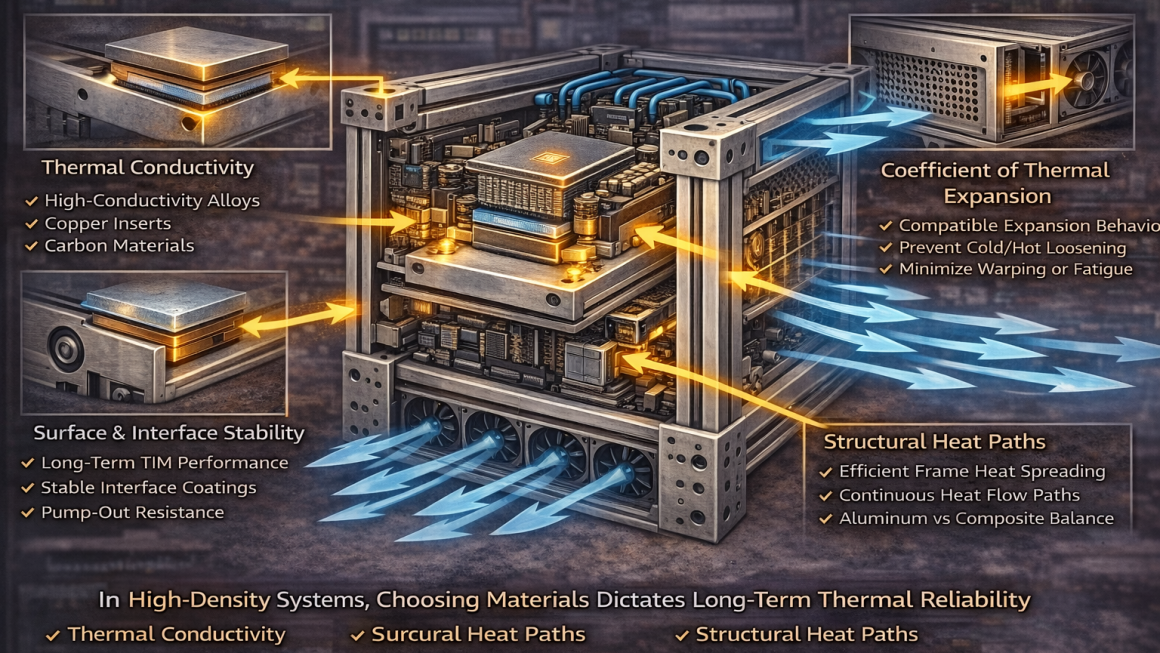
(1) Thermal Conductivity
Materials with higher thermal conductivity spread heat faster and more evenly.
Examples:
- Aluminum alloys for chassis and frames
- Graphite or graphene sheets for spreading
- Thermal interface materials (TIMs)
- Copper inserts in hotspots
Low-conductivity materials create localized hotspots, which accelerate component aging.
(2) Coefficient of Thermal Expansion (CTE)
Different materials expand at different rates when heated.
If CTE mismatch is too large:
- Interfaces loosen
- Solder joints fatigue
- Modules warp
- Thermal resistance increases over time
Selecting materials with compatible expansion behavior is critical for systems that cycle heat daily (AI servers, batteries, power electronics).
(3) Surface & Interface Stability
Thermal performance is not only about bulk material—it’s about interfaces.
Over time:
- Adhesives can dry
- TIMs can pump out
- Coatings can degrade
- Contact resistance increases
Stable materials and coatings maintain consistent thermal pathways for years, not just initial testing.
(4) Structural Heat Path Design
Structural materials can either help or block heat flow.
For example:
- Aluminum chassis can act as a heat spreader
- Composite panels may trap heat
- Poor structural contact increases resistance
- Thin sections create thermal choke points
A well-chosen material turns the entire structure into a passive cooling system.
3. Long-Term Reliability vs Initial Performance
A system may pass thermal testing when new.
But reliability issues appear after months or years.
Material-driven failures often include:
- Gradual temperature rise
- Interface resistance increase
- Deformation under thermal cycling
- Cooling efficiency decline
- Unexpected shutdowns
This is why material selection must consider lifetime behavior, not just initial conductivity numbers.
4. Where Material Choice Matters Most
Material selection is especially critical in:
- High-density AI servers
- Battery energy storage systems
- Power electronics
- Telecom base stations
- Edge computing hardware
In these systems, thermal margins are tight.
Small material differences create large reliability impacts.
5. Design Philosophy: From Cooling to Heat Path Engineering
Instead of asking
“How do we cool this system?”
Engineers increasingly ask
“How do materials move heat through the system?”
This shift leads to:
- Structural heat spreading
- Integrated thermal paths
- Stable interface materials
- Lightweight conductive structures
- Longer service life
Material selection becomes a core reliability strategy, not a secondary decision.
Thermal reliability is not just a cooling problem—it is a materials problem.
The right combination of structural materials, interface layers, and conductive components ensures that heat flows consistently throughout a system’s lifetime.
In high-density, high-power applications, the difference between stable operation and early failure often comes down to a simple question: