

Advanced carbon materials — such as graphene, carbon nanotubes (CNTs), and high-performance graphite — are often positioned as next-generation solutions for thermal, electrical, and structural applications.
And in many cases, they are powerful tools.
But in real engineering practice, they are not automatically the best option.
Material selection is always application-driven, and advanced carbon materials come with trade-offs that must be carefully evaluated.
Let’s look at where expectations and reality sometimes diverge.
1. High Intrinsic Performance ≠ System-Level Advantage
Graphene and CNTs have exceptional intrinsic properties:
- Extremely high thermal conductivity (theoretical)
- Excellent electrical conductivity
- High mechanical strength
- Low density
However, in composite systems:
- Interface resistance dominates
- Dispersion quality limits performance
- Random orientation reduces effective conductivity
- Matrix materials cap achievable gains
In many polymer systems, the final thermal conductivity may only improve marginally — especially at low filler loading.
If the application simply requires moderate thermal conductivity, traditional materials like aluminum, copper, or ceramic fillers may deliver similar performance at lower complexity.
2. Cost vs Performance Balance
Advanced carbon materials are still relatively expensive compared to:
- Aluminum
- Copper
- Graphite powder
- Aluminum nitride
- Boron nitride
If a product does not require:
- Weight reduction
- Multi-functionality
- Ultra-thin structures
- High-end branding differentiation
Then the cost-performance ratio may not justify using graphene or CNTs.
In commercial products, engineering decisions are rarely based on “maximum performance.”
They are based on optimized performance per dollar.
3. Processing Complexity
Carbon nanomaterials introduce processing challenges:
- Agglomeration
- High viscosity at increased loading
- Difficult dispersion control
- Equipment contamination risks
- Quality consistency issues
For large-scale manufacturing, stability and repeatability often matter more than peak lab performance.
A material that is slightly less advanced but easier to process may deliver more reliable production outcomes.
4. Electrical Conductivity Can Be a Problem
Carbon materials are typically electrically conductive.
In some thermal applications, electrical insulation is required:
- Battery pack insulation layers
- High-voltage modules
- PCB isolation structures
- Power electronics packaging
In these cases, ceramic-based fillers (e.g., aluminum oxide, boron nitride) may be more appropriate.
Adding graphene or CNT may create unwanted leakage paths unless carefully engineered.
5. Mechanical Trade-Offs
While carbon nanomaterials can reinforce structures at optimized loading:
- Excess filler can embrittle polymers
- Poor dispersion can create stress concentration points
- Thin coatings may crack under cycling
Mechanical reliability must be validated under real environmental conditions, especially in:
- Automotive
- Energy storage
- Outdoor applications
6. Marketing Hype vs Engineering Need
“Graphene-enhanced” has become a marketing term.
But engineering selection should answer:
- What problem are we solving?
- What failure mode are we preventing?
- What metric are we improving?
- Is the improvement measurable and necessary?
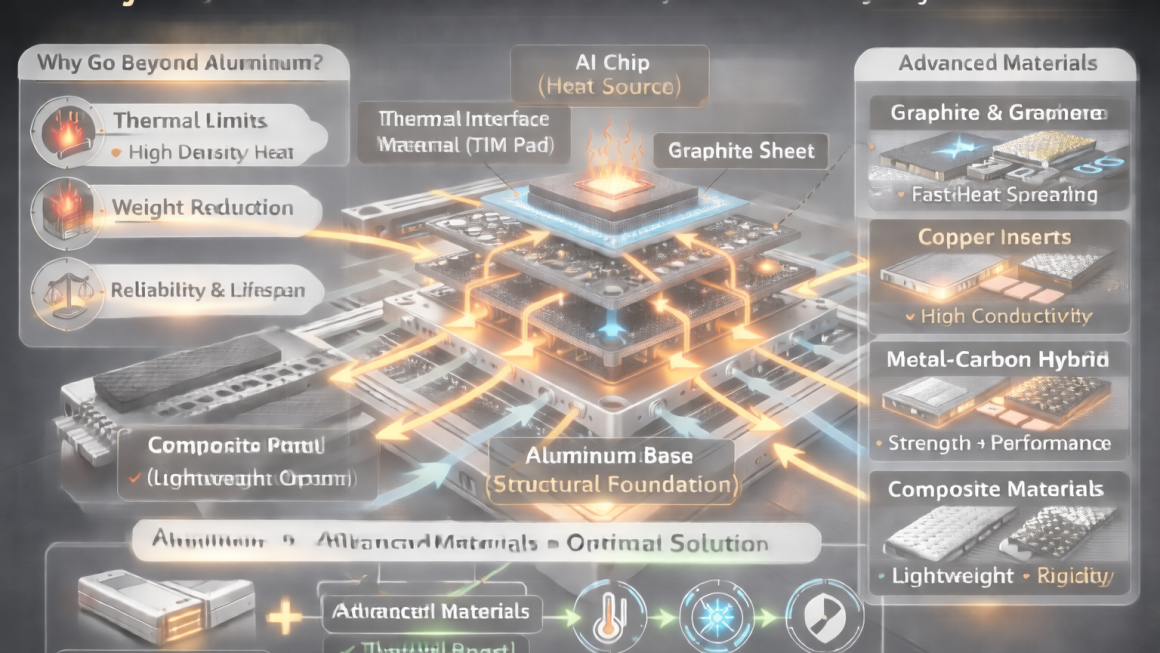
If aluminum already meets thermal targets with acceptable weight and cost, switching to advanced carbon materials may not bring meaningful system-level improvement.
7. Where Advanced Carbon Materials DO Make Sense
They are powerful when:
✔ Weight reduction is critical
✔ Ultra-thin heat spreading is required
✔ Multi-functionality is needed (thermal + EMI + conductivity)
✔ Design space is constrained
✔ Performance ceiling of traditional materials has been reached
In these scenarios, advanced carbon materials are not just alternatives — they are enablers.
8. The Real Engineering Principle
Material selection is not about choosing the most advanced material.
It is about choosing the most appropriate material.
Sometimes that is graphene.
Sometimes it is CNT.
Sometimes it is aluminum.
Sometimes it is ceramic.
The best engineering decisions come from understanding:
Application requirements > System constraints > Cost structure > Manufacturing capability
Not from following trends.