

As AI hardware becomes increasingly power-dense, aluminum frames are no longer just structural elements. They are integral parts of the thermal management system, carrying heat away from chips, power modules, and densely packed electronic boards.
Designing aluminum frames with integrated heat dissipation in mind requires system-level thinking, balancing structure, thermal conductivity, airflow, and manufacturability. This article explores practical strategies and engineering considerations for embedding heat management into aluminum hardware frames.
1. Aluminum: Structural Backbone and Thermal Conductor
Aluminum is widely used in AI hardware for several reasons:
- High thermal conductivity (≈ 200 W/m·K)
- Lightweight yet mechanically robust
- Easy to machine, extrude, and anodize
- Cost-effective and widely available
In AI racks and enclosures, aluminum serves a dual purpose:
- Support and alignment: Holding PCBs, modules, and fans in precise positions
- Thermal path: Acting as a heat sink for components, spreading heat to the chassis or dedicated heat-dissipating surfaces
The challenge lies in designing frames that do both effectively.
2. Key Heat Dissipation Strategies
2.1 Maximizing Surface Area
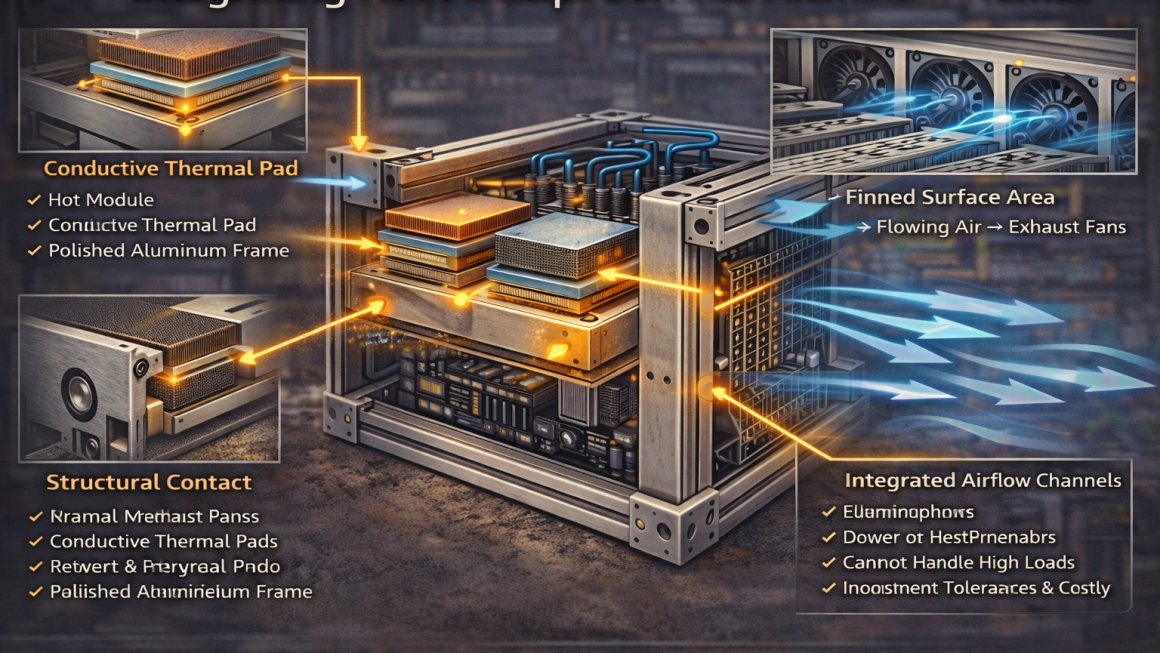
- Use fins, ribbing, and perforations to increase convective surfaces
- Ensure contact surfaces with chips or modules are maximized without compromising structural rigidity
- Consider extrusion designs that integrate airflow channels into the frame
Design tip:
- Airflow paths should match the direction of natural or forced convection. Avoid creating dead zones that trap heat.
2.2 Thermal Interfaces and Pads
Even aluminum frames need optimized interfaces:
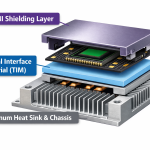
- Thermal pads or phase-change materials (PCMs) help transfer heat from chips to the frame
- Surface flatness and roughness directly impact thermal contact resistance
- Controlled anodizing can protect aluminum while maintaining sufficient thermal conduction
Engineering insight:
- Heat doesn’t travel efficiently through uneven or thickly coated surfaces. Thin, smooth, or polished contact areas matter more than bulk aluminum.
2.3 Conductive Paths Through the Frame
- Design continuous metal paths from high-power modules to heat-dissipating surfaces
- Avoid unnecessary breaks in aluminum structure that create thermal bottlenecks
- Hybrid integration with copper or carbon-enhanced coatings can improve localized heat spreading
Example:
- A GPU module contact area connected via a thick aluminum rail to the outer chassis
- Use conductive interface pads at both ends for minimal resistance
2.4 Airflow Integration
- Heat transfer depends heavily on moving air
- Frames should guide airflow toward hotspots: power modules, CPUs, memory arrays
- Consider perforations, vents, and ducts during frame design
Engineering tip:
- Balance mechanical stiffness with airflow efficiency. Avoid creating weak points in the chassis.
2.5 Mounting and Mechanical Considerations
- Module insertion/removal should not compromise thermal paths
- Spring-loaded or compliant thermal pads can maintain consistent pressure
- Consider vibration damping alongside heat dissipation, especially in rack-mounted servers
3. Thermal Simulation in Frame Design
Before finalizing aluminum frame geometry:
- Perform CFD simulations for airflow and heat transfer
- Identify hotspots and thermal bottlenecks
- Validate that contact points, interface materials, and frame design meet thermal targets
Simulation allows engineers to optimize frame geometry without overdesigning or adding unnecessary materials.
4. Misconceptions to Avoid
- ❌ “Thicker aluminum = better cooling”
→ Thermal spreading depends on path continuity and contact quality, not bulk thickness alone. - ❌ “All frame surfaces should be in contact with chips”
→ Only strategically placed contact areas matter. Unnecessary contact adds cost and complicates assembly. - ❌ “Aluminum frames don’t need thermal planning”
→ In high-density AI modules, the frame can carry significant heat, and ignoring it leads to hotspots and reduced reliability.
5. Practical Guidelines for Engineers
- Define thermal paths early in design, before mechanical layouts are finalized
- Optimize contact areas, pads, and surface treatments for heat transfer
- Incorporate airflow channels into the frame geometry
- Combine aluminum with localized carbon or copper enhancements where needed
- Validate design using simulation and prototype testing
6. Integration Example
A typical AI server frame could integrate heat dissipation as follows:
- Aluminum extrusions form the backbone of the rack
- Heat-generating modules make contact with thin, polished aluminum pads
- Thermal pads transfer heat into the frame rails
- Fins and airflow ducts guide air toward rear exhaust
- Selective carbon coatings enhance interface spreading without replacing aluminum
This approach ensures structural stability and thermal efficiency simultaneously.
Aluminum frames in AI hardware are not just structural elements—they are active components in thermal management.
Effective design requires:
- Maximizing contact and surface area
- Optimizing thermal interface materials
- Guiding airflow efficiently
- Maintaining mechanical integrity
By thinking of the frame as both a support and a heat conductor, engineers can build AI hardware that is reliable, efficient, and scalable, without relying solely on exotic materials.