
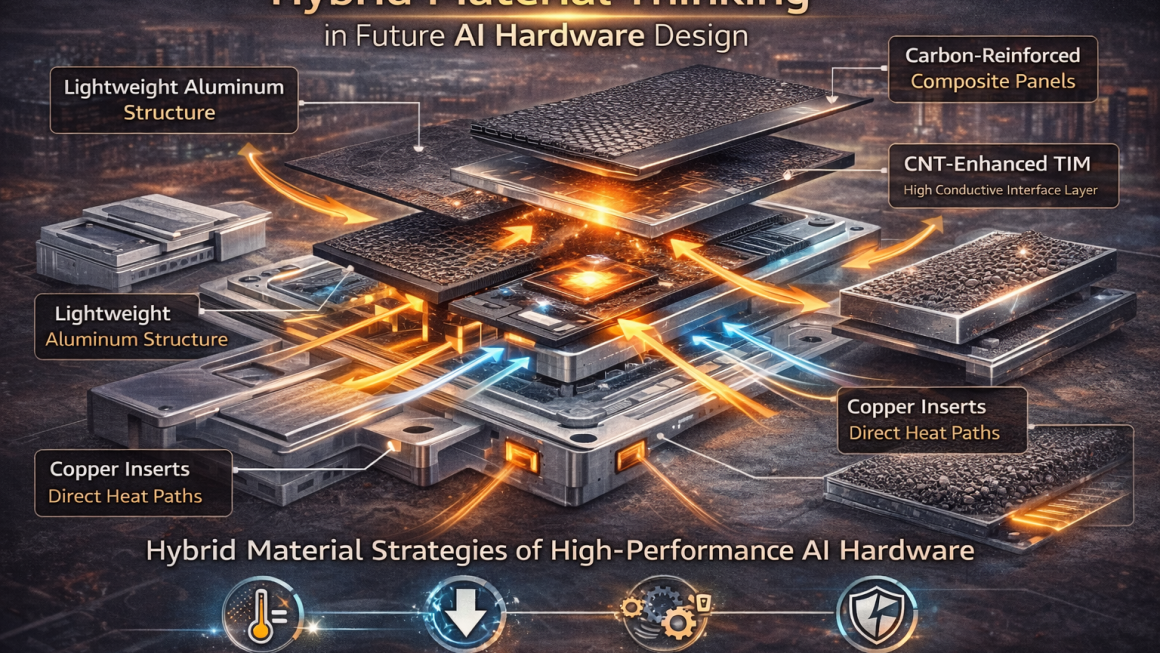
As AI systems move toward higher power density, tighter packaging, and greater thermal stress, traditional single-material solutions are reaching their limits.
Future AI hardware will not be defined by aluminum, copper, or carbon alone — but by hybrid material integration.
The next generation of AI servers, edge devices, and high-density accelerators will require material systems thinking, not material substitution.
1. Why Single-Material Design Is No Longer Enough
Modern AI hardware faces:
- Increasing chip power density
- Concentrated heat flux
- 3D stacking architectures
- Compact rack design
- High reliability requirements
Using only aluminum chassis or only copper heat spreaders solves part of the problem — but not all.
Different functions require different properties:
| Requirement | Ideal Material Characteristic |
|---|---|
| Heat spreading | High in-plane conductivity |
| Heat extraction | High bulk conductivity |
| Weight control | Low density |
| Structural strength | High modulus |
| Electrical insulation | Dielectric behavior |
| EMI shielding | Conductive surface |
No single material optimizes all simultaneously.
2. What Is Hybrid Material Thinking?
Hybrid material thinking means:
Designing thermal and structural systems by combining materials based on function, not tradition.
Instead of asking:
“Should we use aluminum or graphene?”
We ask:
“Which material should handle which thermal or structural role?”
This shift transforms hardware design strategy.
3. Typical Hybrid Architecture in AI Systems
① Metal Core + Carbon Surface Spreaders
- Aluminum or copper frame for structural load
- Graphite or graphene film for in-plane heat spreading
- Carbon-enhanced interface layers
Benefit:
- Improved hotspot spreading
- Reduced localized temperature gradients
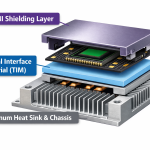
② Copper Inserts + Lightweight Aluminum Structure
- Copper under high-heat chips
- Aluminum frame for weight control
- Carbon-based TIM for interface optimization
Benefit:
- Precision thermal targeting
- Controlled cost
- Balanced mass
③ Carbon-Reinforced Composite Panels
For future lightweight AI systems:
- Carbon fiber composite structural panels
- Embedded conductive layers
- Integrated EMI shielding
Benefit:
- Structural + thermal + EMI in one architecture
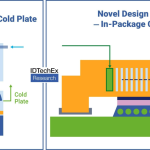
4. Thermal Design Is Now Multi-Directional
AI chips create:
- Vertical heat flux (through-thickness)
- Lateral spreading requirements
- Interface bottlenecks
Hybrid design allows engineers to assign:
- CNT networks → through-thickness conduction
- Graphene sheets → lateral spreading
- Metals → bulk heat extraction
- Ceramics → insulation zones
It becomes a thermal architecture, not a material upgrade.
5. Why AI Hardware Especially Needs Hybrid Thinking
AI accelerators and data center hardware are unique because:
- Power density increases faster than cooling scaling
- Rack density compresses airflow
- Reliability tolerance is extremely tight
- Downtime is expensive
Hybrid materials allow:
✔ Better temperature uniformity
✔ Lower hotspot peaks
✔ Reduced mechanical stress from gradients
✔ Optimized weight-to-performance ratio
✔ Multi-functional integration
6. Design Philosophy Shift
Old approach:
Choose best material → build system around it.
New approach:
Define system constraints → assign materials by function.
This is similar to how advanced aerospace and EV battery systems are designed — by functional layering.
7. The Future Direction
We are moving toward:
- Embedded thermal layers inside chassis
- Integrated spreader frames
- Smart material zoning
- Carbon-metal laminated systems
- Thermal-structural co-design
AI hardware will increasingly look like engineered material ecosystems, not simple metal boxes.
Hybrid material thinking does not replace aluminum, copper, or carbon.
It orchestrates them.
The future of AI thermal reliability will not depend on a single breakthrough material —
but on intelligent integration.