Artificial Intelligence is often discussed in terms of algorithms and software.
But at scale, AI is limited not by code —
it is limited by physics.
Power density.
Thermal load.
Signal integrity.
Mechanical stability.
Electromagnetic interference.
Behind every AI accelerator, server rack, and data center module lies a material system quietly carrying the burden.
This is how we think about materials in AI hardware engineering.
1️⃣ AI Hardware Is a Thermal Problem First
Modern AI chips operate at extremely high power densities.
Training clusters push:
- High current density
- Continuous heavy workloads
- Tight packaging constraints
From a material perspective, the key challenge becomes:
How do we move heat faster than we generate it?
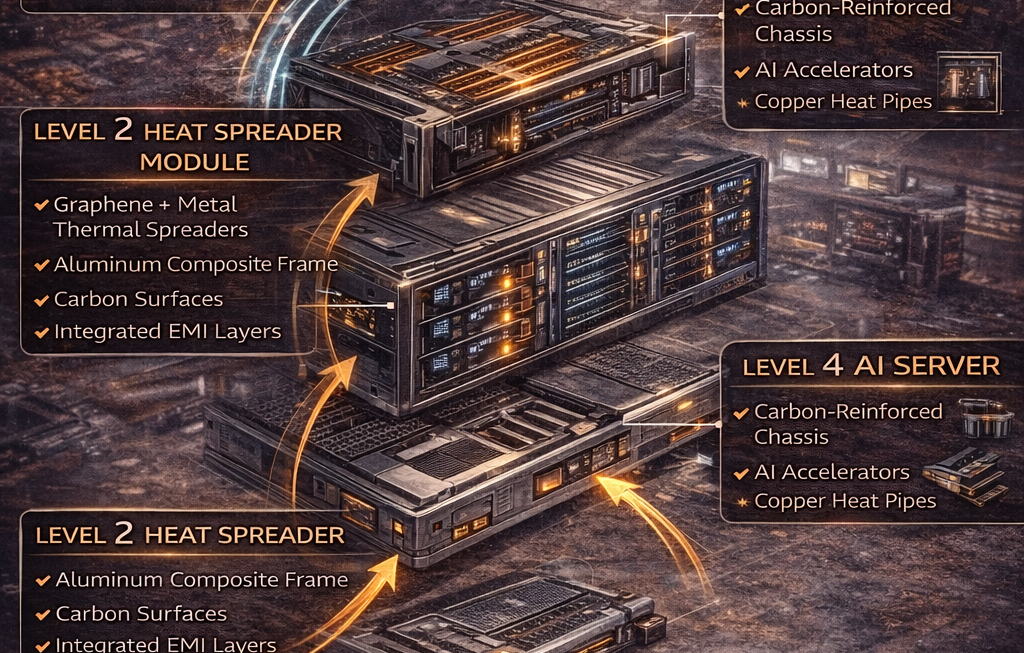
This drives demand for:
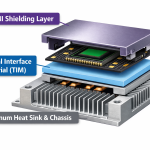
- High thermal conductivity interfaces
- Lightweight heat spreaders
- Carbon-enhanced aluminum systems
- Advanced TIM materials
- Electrically conductive yet thermally optimized layers
Material thinking here is not optional — it is structural.
2️⃣ Power Integrity and Signal Stability
AI hardware requires:
- High-frequency signal transmission
- Stable grounding
- Low EMI interference
At these frequencies, material choice directly affects:
- Surface conductivity
- Shielding effectiveness
- Contact resistance
- Long-term reliability
Carbon-based coatings, graphene films, conductive composites —
they are not just additives.
They become part of the signal architecture.
3️⃣ Weight, Structure, and Modularity
Large AI server systems must be:
- Modular
- Rack-compatible
- Mechanically stable
When systems scale, even small weight reductions matter.
Materials are evaluated not only for performance, but for:
- Stiffness-to-weight ratio
- Vibration tolerance
- Assembly compatibility
- Corrosion resistance in data center environments
A good material improves more than one variable simultaneously.
4️⃣ Manufacturing Compatibility Over Peak Performance
In AI hardware engineering, the best-performing material rarely wins.
The material that wins is:
- Process-compatible
- Scalable
- Supply-stable
- Consistent across batches
A 20% theoretical improvement means little if it disrupts production yield.
Engineering teams prioritize:
Predictable integration over experimental superiority.
5️⃣ System-Level Thinking: Materials as Enablers
We do not ask:
“Is this graphene conductive enough?”
We ask:
- Does it reduce overall cooling cost?
- Does it improve rack density?
- Does it simplify EMI design?
- Does it lower total system energy consumption?
AI infrastructure is a system-of-systems.
Materials that enable architectural simplification create real value.
The Shift in Mindset
Traditional material development focuses on:
- Highest conductivity
- Lowest resistivity
- Strongest mechanical properties
AI hardware engineering focuses on:
- Integration friction
- Thermal bottleneck relief
- Multi-functionality
- System-level ROI
This is a different language.
The Real Question
In AI hardware, materials are not chosen because they are advanced.
They are chosen because they remove constraints.
When a material:
- Improves heat dissipation
- Maintains signal integrity
- Reduces weight
- Remains scalable
It becomes an infrastructure enabler.
And in AI, infrastructure wins.