As artificial intelligence systems continue to scale, AI servers are becoming more powerful, more densely packed, and more thermally demanding. While processors, accelerators, and networking hardware often receive the most attention, another critical factor quietly determines long-term system stability: structural materials.
The materials used in server frames, chassis, mounting systems, and internal support structures play a fundamental role in determining reliability, thermal stability, and mechanical durability. In high-density AI infrastructure, structural engineering is no longer simply about holding components together—it directly influences performance and operational lifespan.
Structural Stability in High-Density Systems
Modern AI servers can weigh significantly more than traditional enterprise servers. With multiple GPUs, high-capacity power supplies, advanced cooling systems, and complex networking hardware, the mechanical load inside each rack continues to increase.
Structural materials must provide:
- High mechanical strength
- Dimensional stability
- Resistance to deformation over time
If the frame or mounting structure deforms under load, even slightly, it can lead to misalignment of critical components such as GPUs, cooling plates, and connectors. Over time, this misalignment can create mechanical stress on circuit boards and thermal interfaces.
Materials such as aluminum alloys are widely used because they offer an excellent balance between strength and weight, helping maintain structural integrity without dramatically increasing system mass.
Vibration and Fatigue Resistance
AI data centers contain thousands of moving components, including:
- High-speed cooling fans
- Pump systems in liquid cooling setups
- Airflow-driven vibrations in rack structures
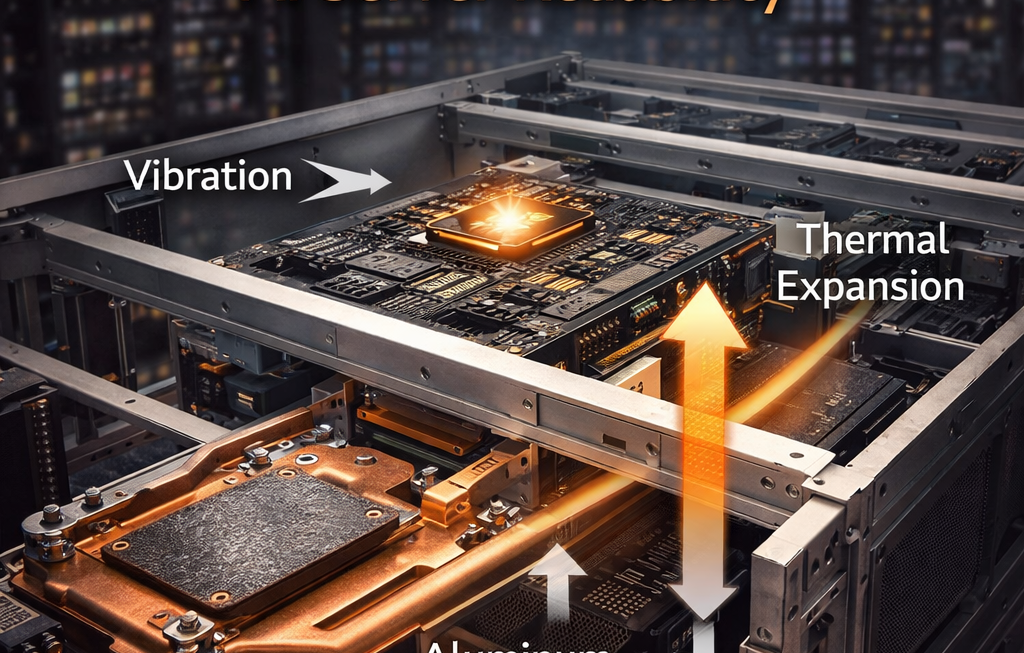
These forces generate continuous mechanical vibration throughout the server environment. If structural materials are not designed to absorb or resist these forces, fatigue damage can develop over long periods of operation.
Material selection therefore plays a role in preventing:
- Fastener loosening
- Micro-cracking in structural components
- Connector fatigue
- Long-term frame deformation
Proper structural materials combined with thoughtful mechanical design help ensure that AI servers can operate reliably for many years in demanding environments.
Thermal Expansion and Mechanical Stress
Another key reliability factor is thermal expansion.
AI servers experience large temperature gradients during operation. Accelerators, CPUs, and power electronics generate heat, and cooling systems attempt to remove that heat continuously.
Different materials expand at different rates when exposed to temperature changes. If the structural frame and internal components expand unevenly, this can create mechanical stress inside the system.
For example:
- Printed circuit boards
- Heat sinks
- Mounting brackets
- Thermal interface materials
must all remain aligned during repeated heating and cooling cycles.
Aluminum is commonly used in structural frames partly because its thermal expansion behavior is predictable and manageable, allowing engineers to design systems that accommodate thermal movement without damaging sensitive components.
Weight Distribution and Rack-Level Reliability
Reliability is not only about individual servers—it also affects rack-level infrastructure.
AI racks may contain multiple heavy GPU servers stacked vertically. If the structural materials of each server add excessive weight, the total load on rack rails and data center floors increases significantly.
Lightweight structural materials help:
- Reduce rack stress
- Improve installation safety
- Lower shipping and handling risks
- Simplify maintenance operations
Aluminum’s relatively low density makes it particularly well suited for large structural assemblies where both strength and weight efficiency are important.
Manufacturing Precision and Tolerances
Structural materials must also support precise manufacturing tolerances.
Modern AI servers require extremely accurate alignment between components, especially when integrating:
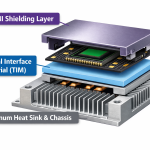
- Direct-to-chip cooling plates
- High-speed connectors
- GPU mounting brackets
- Airflow channels
If structural components are difficult to manufacture accurately, system reliability may suffer due to assembly inconsistencies.
Aluminum structures are often produced using extrusion, CNC machining, or precision sheet metal forming, allowing engineers to maintain tight tolerances while still supporting large-scale production.
Compatibility with Advanced Cooling
As liquid cooling and hybrid cooling architectures become more common in AI infrastructure, structural materials must also integrate well with these systems.
Frames and chassis may support:
- Coolant manifolds
- Pump assemblies
- Cold plate mounting systems
- Thermal interface materials
Materials must remain stable in environments where temperature fluctuations and moisture control become more critical. Corrosion resistance and surface treatment compatibility also become important considerations.
Reliability Through Material Engineering
In many ways, structural materials form the foundation of reliable AI hardware. While processors drive computational performance, the mechanical architecture ensures the system can operate safely and consistently over time.
Effective structural materials contribute to reliability by enabling:
- Mechanical stability
- Controlled thermal expansion
- Vibration resistance
- Efficient weight distribution
- Precise manufacturing
When these factors are balanced correctly, AI servers can maintain performance stability across years of continuous operation.
In the rapidly evolving world of AI infrastructure, reliability is not determined by electronics alone. Structural materials play a crucial role in maintaining the mechanical, thermal, and operational stability of high-performance systems.
By carefully selecting materials such as aluminum alloys and designing structures that balance strength, weight, and thermal behavior, engineers create server platforms capable of supporting the demanding workloads of modern artificial intelligence.
As AI hardware continues to scale in power and complexity, structural material engineering will remain a key factor in building reliable and resilient data center infrastructure.