


In advanced material development — whether in graphene, carbon composites, or hybrid aluminum systems — a common question arises:
How can engineers make adoption decisions before mass production even exists?
Because in reality, most breakthrough materials never reach scale. Not because they fail technically — but because they fail evaluation.
This article explores how experienced engineering teams systematically evaluate new materials before committing to large-scale manufacturing.
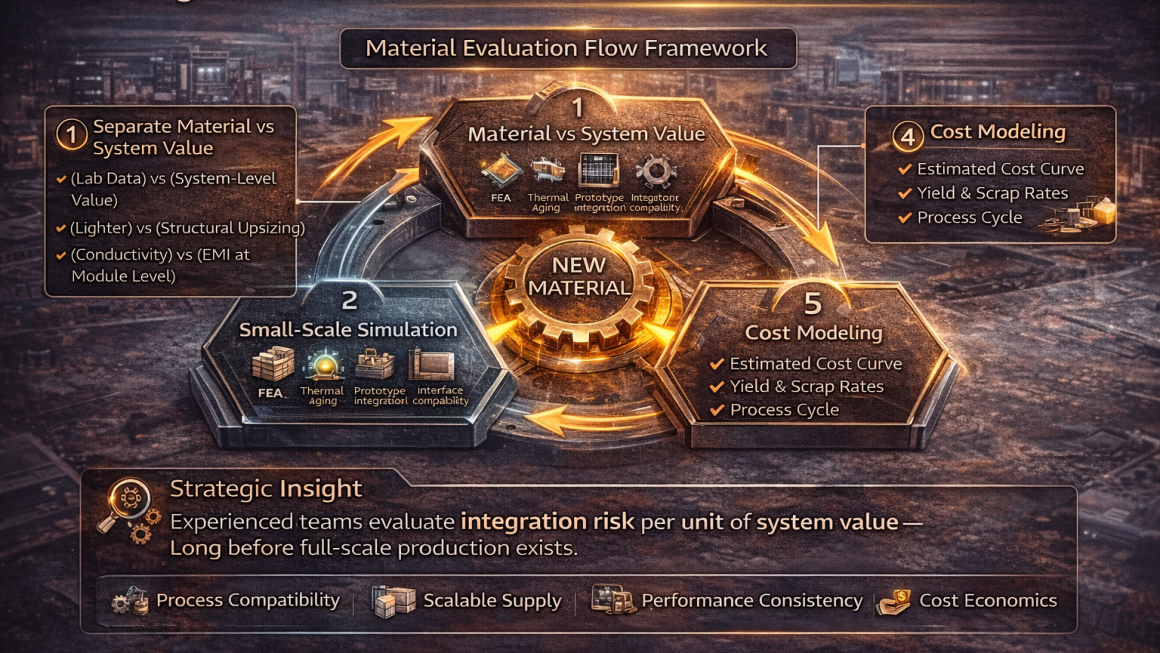
1️⃣ Step One: Separate Material Performance from System Value
A lab report may show:
- 2× thermal conductivity
- 30% weight reduction
- Higher electrical conductivity
But engineers ask a different question:
Does this improve the system — not just the material?
For example:
- Does higher thermal conductivity actually reduce heat sink size?
- Does lighter weight reduce structural reinforcement?
- Does conductivity improve EMI shielding at the module level?
If performance stays isolated at the material layer, adoption probability is low.
2️⃣ Small-Scale Simulation Before Big-Scale Investment
Before any mass production decision, teams typically move through:
- Finite Element Simulation (FEA)
- Thermal modeling
- Accelerated life testing
- Small batch prototype integration
At this stage, the focus shifts from “spec sheet advantage” to:
- Interface compatibility
- Coefficient of thermal expansion (CTE) matching
- Adhesion stability
- Aging behavior
This is where many promising materials quietly exit the pipeline.
3️⃣ Process Compatibility Assessment
A new material must pass three invisible gates:
✔ Manufacturing Compatibility
- Can it run on existing lines?
- Does it require new equipment?
- Is yield predictable?
✔ Supply Chain Stability
- Are raw materials scalable?
- Is quality variation controllable?
✔ Certification Pathway
- Does it impact UL / IEC / automotive standards?
- Will re-certification delay product release?
If adoption forces major disruption, decision-makers hesitate.
4️⃣ Cost Modeling Before Volume Exists
Even without mass production, engineers and procurement teams model:
- Estimated cost curve at scale
- Yield sensitivity
- Scrap impact
- Process cycle time
This creates a theoretical production scenario — not based on hope, but on conservative assumptions.
If projected system-level savings outweigh risk-adjusted cost, the project moves forward.
5️⃣ Risk Mapping Instead of Risk Avoidance
Experienced teams do not try to eliminate risk.
They map it.
Typical early-stage risk matrix includes:
| Risk Type | Example |
|---|---|
| Technical | Delamination, thermal fatigue |
| Operational | Training complexity |
| Supply | Raw material bottleneck |
| Business | Market adoption uncertainty |
The goal is not perfection.
The goal is controlled exposure.
6️⃣ Pilot Validation: The Real Decision Point
Mass production rarely begins immediately.
Instead:
- Lab validation
- Engineering sample
- Limited pilot run
- Controlled field test
Only after data consistency across these layers does scaling become rational.
Key Insight
Engineers do not evaluate materials.
They evaluate:
Integration risk per unit of system value.
That is the real formula.
A material with moderate performance but low integration friction often wins over a high-performance but disruptive alternative.
Strategic Reflection
For advanced carbon or graphene materials, success depends less on peak properties — and more on:
- Process compatibility
- Scalable supply
- Predictable performance
- System-level ROI
Innovation does not fail because it is weak.
It fails because it is not engineered for adoption.