

As AI hardware power density rises, thermal management has become one of the most critical system-level design challenges. Graphene and carbon nanotubes (CNT) are often promoted as “ultra-high thermal conductivity” materials—but in real hardware systems, their role is far more specific.
They are not magic replacements for aluminum, copper, or traditional thermal paths. Instead, they function best as interface enhancers, conductivity modifiers, and reliability stabilizers within an existing thermal architecture.
Understanding **where they help—and where they don’t—**is essential for realistic engineering integration.
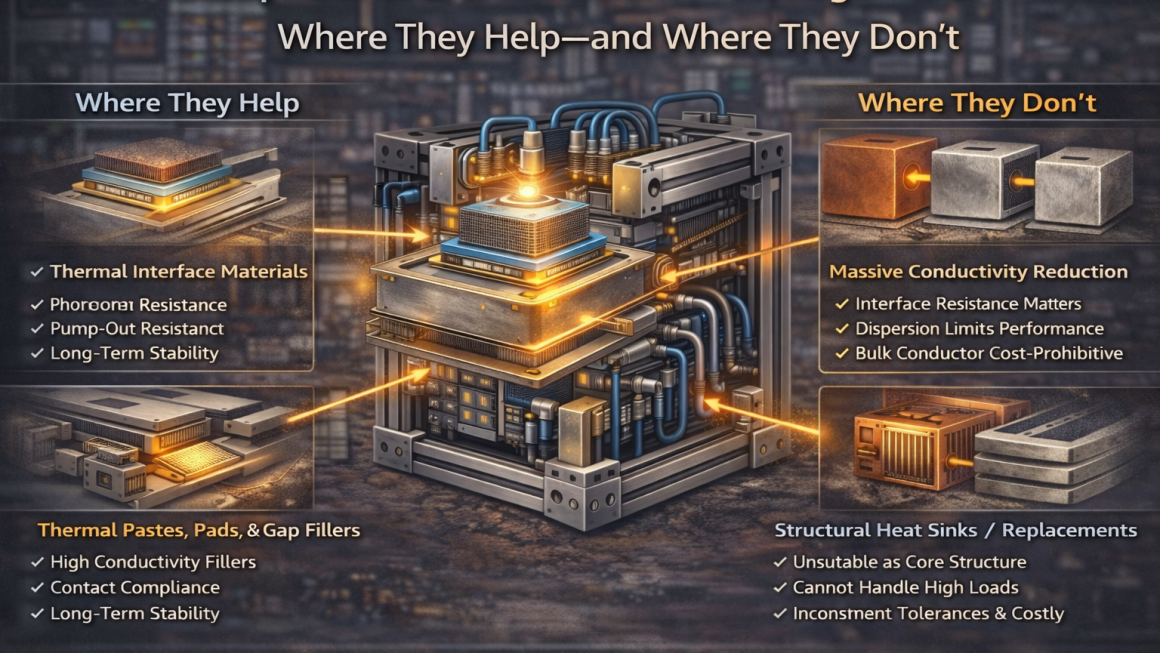
1. Where Graphene & CNT Actually Help
1️⃣ Thermal Interface Materials (TIMs)
Biggest impact area
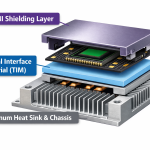
Between chips, heat spreaders, and aluminum frames, thermal resistance often comes from interfaces, not bulk materials.
Graphene/CNT improve:
- Contact conductivity
- Gap filling
- Pump-out resistance
- Long-term stability
Typical gains:
- Lower interface resistance
- More stable performance over time
- Reduced dry-out vs standard pastes
Key insight:
Even small loading levels can significantly improve TIM performance because percolation pathways form at interfaces.
2️⃣ Thermal Pastes, Pads, and Gap Fillers
Carbon materials help when:
- Thickness must remain low
- Mechanical compliance is required
- Electrical isolation must be tuned
Benefits:
- Higher thermal conductivity at lower filler loading
- Better dispersion stability
- Reduced sedimentation
Most effective in:
- AI server heat spreaders
- Edge computing modules
- Battery-adjacent electronics
- Power modules
3️⃣ Heat Spreader Enhancement (Composite Approach)
Graphene/CNT are sometimes added to:
- Aluminum plates
- Polymer heat spreaders
- Encapsulation layers
Here they help:
- Spread localized hotspots
- Improve in-plane heat distribution
- Stabilize thermal cycling behavior
But they do not replace metal as the main heat conductor.
4️⃣ Reliability and Lifetime Stability
Carbon additives improve:
- Thermal cycling resistance
- Micro-crack suppression
- Interface durability
- Pump-out resistance
This matters in:
- AI servers running 24/7
- Outdoor edge systems
- Vibration environments
Their role is often lifetime stabilization, not peak conductivity.
2. Where They Don’t Help (Common Misconceptions)
❌ Replacing Aluminum or Copper Structures
Carbon materials:
- Cannot replace structural heat sinks
- Cannot carry large thermal loads alone
- Are not cost-effective as bulk conductors
Metal still dominates bulk heat transfer.
❌ Massive Thermal Conductivity Boosts Everywhere
Lab values:
- Graphene: extremely high conductivity
- CNT: very high conductivity
Real systems:
- Interface resistance dominates
- Dispersion limits performance
- Contact quality matters more
Result:
System-level improvement is usually incremental but meaningful, not revolutionary.
❌ Structural Frame Replacement
Graphene/CNT:
- Not structural load materials
- Not cost-effective for large frames
- Hard to scale in bulk hardware
They function best as functional additives, not structural elements.
3. The Real Engineering Role
In AI hardware systems, carbon materials act as:
Performance multipliers inside existing designs
They:
- Improve interfaces
- Stabilize thermal paths
- Enhance reliability
- Reduce long-term degradation
They do NOT:
- Replace metal heat paths
- Eliminate cooling design
- Solve poor mechanical layout
4. Integration Logic for AI Hardware
Best-fit applications:
- TIMs between chip & heat spreader
- Thermal pastes and pads
- Encapsulation materials
- Composite heat spreaders
- Hotspot mitigation layers
Less suitable:
- Large structural frames
- Primary heat sinks
- Bulk conductive plates
5. System-Level Perspective
Thermal performance depends on:
Structure → Interface → Material → Stability
Graphene and CNT primarily improve:
- Interface performance
- Long-term stability
- Local heat spreading
They are precision tools, not universal solutions.
In AI hardware thermal design:
Metals move heat.
Interfaces limit heat.
Carbon materials improve interfaces.
Graphene and CNT are most valuable when used strategically, not universally.
When integrated correctly, they enhance system reliability and efficiency—but only as part of a well-designed thermal path.