

As thermal loads increase in AI hardware, power electronics, and energy storage systems, engineers are no longer treating aluminum as a standalone solution. Instead, aluminum is being enhanced with carbon-based materials — such as graphene, CNTs, graphite films, or carbon composites — to improve heat spreading, reduce hotspots, and enable multi-functional integration.
However, combining aluminum with carbon is not a simple material upgrade. It is a system-level engineering decision.
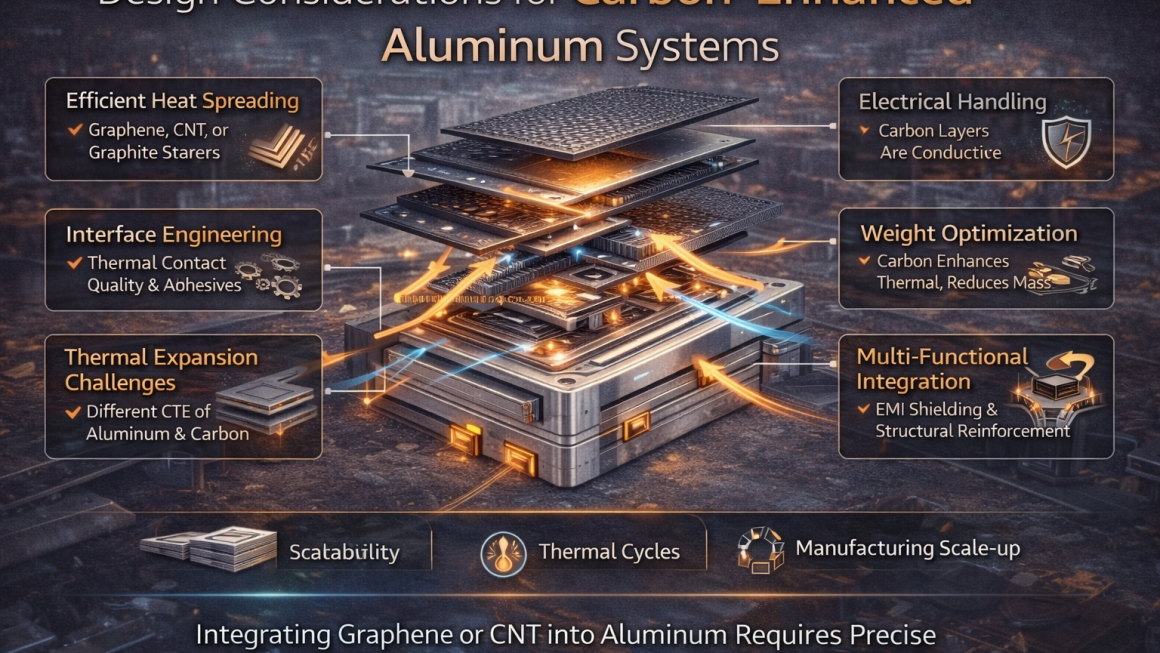
Below are the key design considerations when developing carbon-enhanced aluminum systems.
1. Define the Thermal Objective First
Before selecting any carbon additive, clarify:
- Are you solving hotspot reduction?
- Improving in-plane spreading?
- Enhancing through-thickness conduction?
- Reducing weight?
- Integrating EMI shielding?
Different carbon forms serve different purposes:
| Carbon Material | Strength |
|---|---|
| Graphene films | Excellent in-plane heat spreading |
| CNT networks | Through-thickness conductive pathways |
| Graphite sheets | Cost-effective lateral spreading |
| Carbon composites | Structural + thermal integration |
Without a clear objective, carbon enhancement may add cost without measurable gain.
2. Interface Engineering Is Critical
The weakest link in carbon-aluminum systems is often the interface.
Challenges include:
- Thermal contact resistance
- Surface roughness mismatch
- Adhesive layer conductivity
- Mechanical delamination risk
Key strategies:
✔ Surface treatment (anodizing considerations)
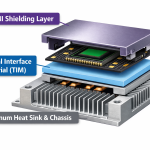
✔ High-performance thermal interface materials (TIM)
✔ Pressure-controlled bonding
✔ Hybrid adhesive + mechanical fixation
In many systems, improving interface quality delivers more benefit than increasing carbon loading.
3. Thermal Expansion Compatibility
Aluminum and carbon materials have different coefficients of thermal expansion (CTE):
- Aluminum: relatively high CTE
- Graphite/graphene: very low in-plane CTE
Under thermal cycling, this mismatch may cause:
- Warping
- Stress accumulation
- Micro-cracking
- Long-term reliability concerns
Design mitigation approaches:
- Flexible bonding layers
- Zoned material placement
- Mechanical stress-relief structures
- Controlled carbon orientation
Thermal reliability must be validated under real operating cycles.
4. Electrical Behavior Considerations
Carbon materials are electrically conductive.
When integrating into aluminum systems, consider:
- Is electrical isolation required?
- Are there high-voltage zones nearby?
- Will carbon layers create unintended conductive paths?
In battery modules or power electronics, dielectric barriers may be necessary.
Thermal performance cannot compromise electrical safety.
5. Weight vs Performance Optimization
One major reason to enhance aluminum with carbon is weight reduction.
Instead of:
Thicker aluminum to handle heat
Engineers can use:
Thinner aluminum + carbon spreader layer
This can deliver:
✔ Similar thermal performance
✔ Lower total mass
✔ Better temperature uniformity
However, cost analysis must verify that performance gains justify material complexity.
6. Manufacturing Scalability
Carbon-enhanced systems must be manufacturable at scale.
Consider:
- Film lamination consistency
- Adhesive curing processes
- Handling sensitivity of thin carbon films
- Quality control methods
Lab prototypes often perform well.
Mass production requires repeatability.
Scalability determines commercial success.
7. Multi-Functional Integration Opportunity
Carbon-enhanced aluminum systems can provide more than thermal benefits:
- EMI shielding
- Structural reinforcement
- Surface durability
- Electrical grounding control
Future AI and energy systems increasingly demand multi-functional components.
A well-designed hybrid system reduces part count and improves integration.
8. When Carbon-Enhanced Aluminum Makes the Most Sense
This architecture is particularly effective in:
✔ High-density AI accelerators
✔ EV battery enclosures
✔ Power electronics modules
✔ Lightweight industrial equipment
✔ Aerospace electronics
Especially when hotspot management and weight constraints coexist.
Final Engineering Perspective
Carbon-enhanced aluminum systems are not about replacing aluminum.
They are about:
Assigning carbon to precision thermal roles
Keeping aluminum for structural efficiency
The success of this approach depends less on material novelty and more on:
- Interface design
- Thermal pathway planning
- Reliability validation
- Cost-performance optimization
In advanced hardware systems, the future is not metal vs carbon.
It is metal + carbon — intelligently integrated.