

In advanced hardware systems — from AI accelerators to EV battery platforms — material innovation often promises dramatic performance gains. Yet history shows that technical superiority alone does not guarantee adoption.
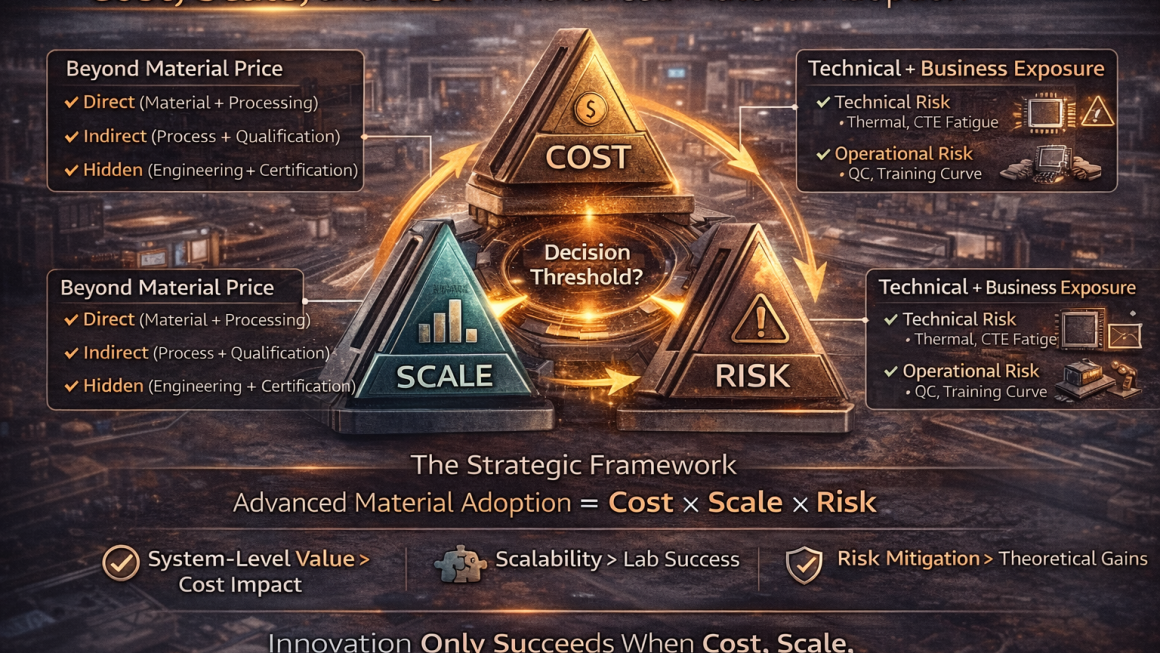
The real decision framework revolves around three forces:
Cost. Scale. Risk.
Understanding how these interact is essential when introducing advanced materials such as graphene, carbon composites, engineered alloys, or hybrid thermal systems.
1️⃣ Cost: Beyond Material Price
When evaluating advanced materials, many teams focus only on raw material cost.
However, total cost impact includes multiple layers:
Direct Cost
- Material price per kg or m²
- Processing cost (machining, lamination, bonding)
- Yield loss
Indirect Cost
- Tooling modification
- Process validation
- Supply chain qualification
- Reliability testing
Hidden Cost
- Design iteration delays
- Engineering time
- Certification requirements
- Warranty exposure
In many cases:
A 20% material cost increase may result in a 5% total system cost increase —
or a 30% increase if integration complexity is high.
Cost must always be evaluated at the system level, not the material level.
2️⃣ Scale: Lab Success vs Manufacturing Reality
Many advanced materials perform exceptionally in controlled environments.
But scaling introduces new constraints:
Manufacturing Consistency
- Thickness uniformity
- Interface quality repeatability
- Mechanical tolerances
Supply Stability
- Single-source dependency
- Geographic concentration
- Raw material volatility
Throughput Compatibility
- Does the material slow assembly?
- Does it require new curing or bonding steps?
- Does it reduce automation efficiency?
A material that works in a 100-unit pilot may fail at 100,000 units annually.
Scalability determines commercial viability.
3️⃣ Risk: Technical and Business Exposure
Advanced material adoption carries layered risk.
Technical Risk
- Long-term degradation unknowns
- Thermal cycling reliability
- CTE mismatch stress
- Interface delamination
Operational Risk
- New process learning curve
- Operator training
- Quality control complexity
Market Risk
- Performance improvement insufficient to justify cost
- Competitor using simpler solution
- Customer resistance to unproven materials
Risk perception often outweighs theoretical performance gains.
4️⃣ The Adoption Threshold Concept
Organizations adopt advanced materials when three conditions align:
✔ Clear performance bottleneck cannot be solved conventionally
✔ System-level value outweighs integration complexity
✔ Risk mitigation roadmap is defined
Without all three, adoption stalls.
5️⃣ Early vs Late Adoption Strategy
Different companies approach material innovation differently:
Performance Leaders
- Willing to absorb higher cost
- Accept controlled risk
- Seek differentiation
Fast Followers
- Wait for validation
- Adopt once reliability is proven
- Optimize cost
Cost Leaders
- Avoid unless mandatory
- Use mature materials
- Prioritize manufacturing simplicity
Understanding the customer’s innovation profile is critical when proposing advanced materials.
6️⃣ De-Risking Advanced Material Integration
Successful adoption strategies often include:
- Hybrid designs (partial integration first)
- Redundant validation testing
- Clear ROI modeling
- Supply chain dual sourcing
- Gradual production ramp
The goal is not eliminating risk —
but making it predictable and manageable.
7️⃣ When Advanced Materials Make Strategic Sense
Advanced material adoption becomes rational when:
- Thermal density exceeds aluminum-only limits
- Weight reduction has direct economic value (EV range, aerospace fuel)
- Reliability gains reduce warranty cost
- Integration reduces component count
Material innovation must tie directly to measurable business metrics.
Advanced materials are not chosen because they are new.
They are chosen when:
Performance necessity + System economics + Risk management
intersect at the right moment.
The companies that succeed in advanced hardware design are not those who chase novelty.
They are those who understand:
- When to innovate
- When to hybridize
- When to wait
In the future of AI hardware, energy systems, and high-density electronics,
material strategy is business strategy.