
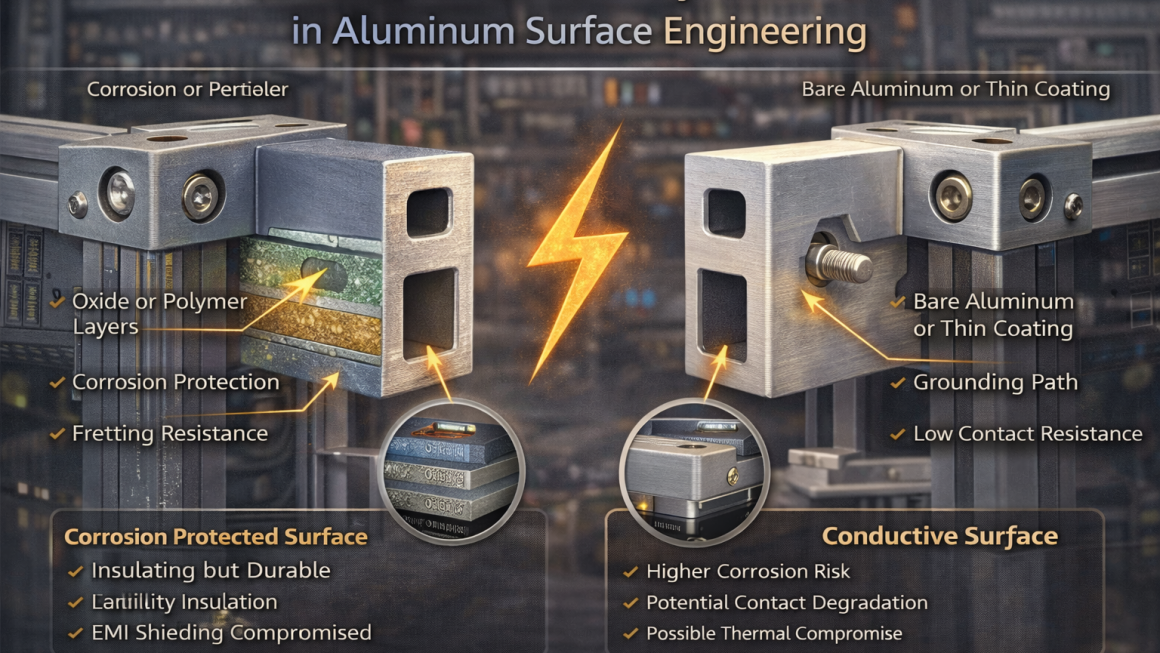
Aluminum is widely used in AI hardware structures because it offers a rare balance of lightweight, strength, and thermal performance.
However, when aluminum is placed in real AI environments—high power density, continuous operation, and strict electrical requirements—engineers face a recurring dilemma:
Should aluminum surfaces prioritize corrosion protection or electrical conductivity?
In many cases, improving one comes at the expense of the other. This article explores the engineering trade-offs between corrosion resistance and electrical conductivity in aluminum surface engineering, and how these choices affect long-term system performance.
1. Why This Trade-Off Exists
1.1 Aluminum’s Natural Oxide Layer
Aluminum forms a thin oxide layer naturally when exposed to air. This layer:
- Protects against corrosion
- Is electrically insulating
- Has limited thermal conductivity
While this natural oxide is thin, engineered surface treatments often amplify its effects, making trade-offs unavoidable.
2. Corrosion Protection: What Engineers Gain
2.1 Why Corrosion Still Matters in AI Systems
Even in climate-controlled data centers, aluminum surfaces face:
- Humidity fluctuations
- Cleaning agents and maintenance chemicals
- Long-term exposure to airborne contaminants
Corrosion may not cause immediate failure, but it can lead to:
- Surface pitting
- Increased contact resistance
- Reduced mechanical integrity over time
2.2 Common Corrosion-Focused Treatments
- Anodizing (standard or hard)
- Conversion coatings
- Polymer-based protective coatings
These treatments extend structural life but often reduce surface conductivity.
3. Electrical Conductivity: Why It Cannot Be Ignored
3.1 Grounding and EMI Control
In AI racks, aluminum frames often serve as:
- Grounding paths
- EMI shielding structures
- Mechanical references for signal stability
Poor electrical continuity can cause:
- Ground loops
- Increased electromagnetic noise
- Inconsistent system behavior
3.2 Contact Interfaces Are Critical
Conductivity matters most at:
- Frame-to-frame joints
- Rack mounting points
- Shielding interfaces
- Cable management structures
At these locations, insulating surface layers can undermine electrical design intent.
4. How Surface Treatments Shift the Balance
4.1 Anodizing: Protection at a Cost
Advantages:
- Excellent corrosion resistance
- Improved wear performance
Trade-Offs:
- Electrically insulating
- May require selective masking or post-processing
- Can increase contact resistance at joints
Anodizing works best when electrical continuity is managed intentionally, not assumed.
4.2 Bare or Lightly Treated Aluminum
Advantages:
- Excellent electrical conductivity
- Low contact resistance
Trade-Offs:
- Higher corrosion risk
- Surface degradation over time
- Requires controlled environment
This approach may work in short lifecycle or tightly controlled installations, but risks increase with time.
4.3 Hybrid Approaches
Many AI systems use mixed strategies:
- Conductive contact points left untreated or lightly treated
- Structural surfaces protected with anodizing
- Grounding zones mechanically broken through coatings
This method demands clear engineering documentation to avoid assembly errors.
5. Mechanical and Thermal Side Effects
5.1 Mechanical Stability
- Insulating coatings reduce fretting and wear
- Bare aluminum can develop micro-movement damage at joints
5.2 Thermal Interfaces
- Thick coatings increase thermal resistance
- Polished or lightly treated surfaces improve thermal contact
- Trade-offs affect long-term heat dissipation stability
Thermal, electrical, and mechanical behaviors are tightly coupled.
6. Common Engineering Misconceptions
❌ “Anodized aluminum cannot be grounded”
→ It can, but grounding must be designed, not assumed.
❌ “Bare aluminum is always better electrically”
→ Initially yes, but corrosion can degrade conductivity over time.
❌ “One surface treatment fits the entire frame”
→ In AI systems, functional zoning is essential.
7. Practical Design Guidelines
For AI hardware aluminum structures:
- Define electrical grounding zones early in design
- Use selective surface treatment, not blanket coatings
- Keep thermal contact surfaces smooth and minimally treated
- Document coating thickness and contact requirements
- Align mechanical, electrical, and thermal teams on surface strategy
Good surface engineering is a system-level decision, not a finishing step.
In aluminum surface engineering for AI environments, the choice between corrosion resistance and electrical conductivity is rarely binary.
The real challenge is managing the trade-off intelligently:
- Protect where durability matters
- Conduct where electrical performance is critical
- Design interfaces that acknowledge both
As AI systems grow in power density and operational lifespan, surface engineering decisions increasingly shape long-term reliability.