

Aluminum has long been the default structural material for electronics, AI servers, energy systems, and industrial hardware. Its balance of strength, weight, cost, and thermal conductivity makes it the backbone of modern hardware design.
However, as systems become denser, hotter, and more performance-driven, engineers are increasingly asking a new question:
When is aluminum no longer enough?
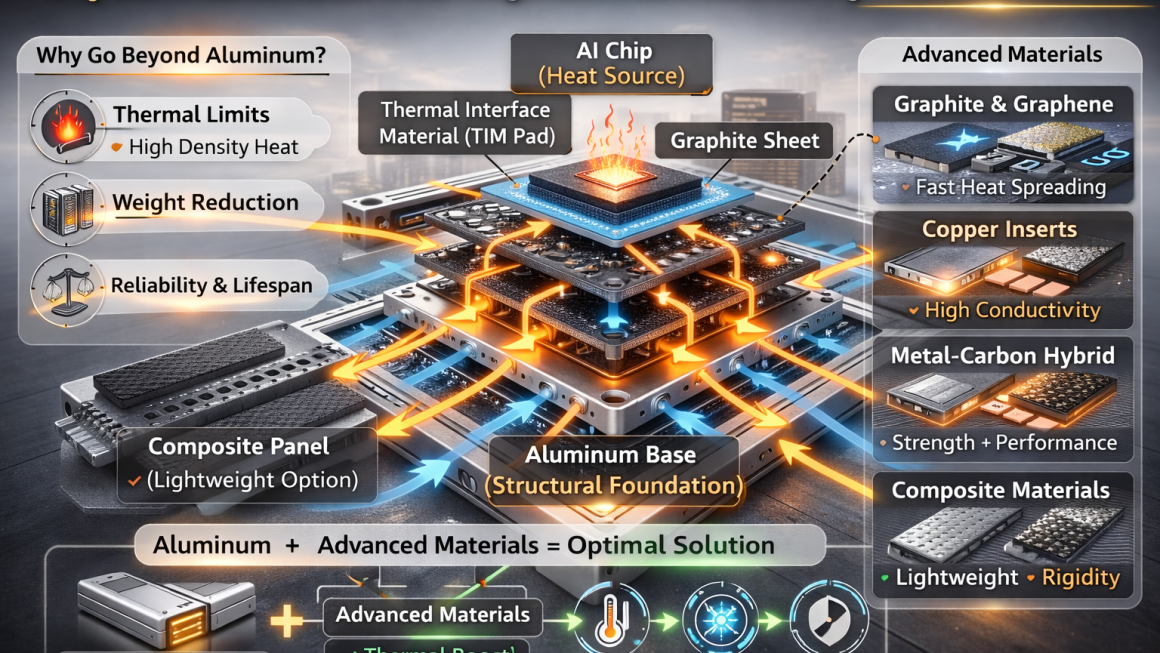
This doesn’t mean aluminum is being replaced. In most cases, it remains the structural foundation. But advanced materials—carbon-based, hybrid metals, and engineered interfaces—are now being introduced to solve specific limitations.
This article explores when engineers begin considering advanced materials, why they do so, and how these materials are typically integrated alongside aluminum rather than instead of it.
1. The Limits of Aluminum in High-Density Systems
Aluminum performs well across many applications, but in extreme conditions its limitations begin to appear.
Thermal Density Limits
As power density rises:
- Heat becomes more localized
- Spreading requirements increase
- Aluminum alone may not distribute heat fast enough
Weight vs Rigidity Trade-offs
In large structures:
- Thicker aluminum improves stiffness
- But increases weight
- And may not improve thermal spreading proportionally
Interface Performance
Aluminum interfaces rely heavily on:
- Thermal pads
- Surface treatments
- Contact pressure
Over time, these interfaces can degrade, affecting long-term thermal reliability.
When systems push beyond these limits, engineers start exploring complementary materials.
2. Common Triggers for Advanced Material Consideration
Engineers typically begin evaluating advanced materials when:
- Thermal hotspots exceed safe margins
- Cooling systems reach efficiency limits
- Structural weight becomes critical
- Long-term reliability targets increase
- Compact design constraints tighten
This often happens in:
- AI training servers
- High-performance computing
- Battery systems
- Power electronics
- Aerospace electronics
The goal is rarely to replace aluminum entirely, but to enhance specific functions.
3. Types of Advanced Materials Being Considered
3.1 Carbon-Based Thermal Spreaders
Materials like:
- Graphite sheets
- Graphene-enhanced layers
- Carbon composites
are used to improve in-plane heat spreading.
They are typically applied:
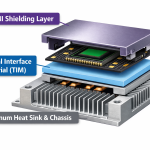
- Between chips and aluminum frames
- Inside chassis panels
- As thermal interface enhancements
These materials help distribute heat quickly across surfaces before aluminum carries it away.
3.2 Hybrid Metal Structures
Engineers sometimes integrate:
- Copper inserts in aluminum frames
- Heat pipes
- Vapor chambers
- Metal-carbon laminates
These solutions improve localized heat transfer while maintaining structural integrity.
3.3 Lightweight Structural Composites
In weight-sensitive applications:
- Carbon fiber composites
- Aluminum-composite hybrids
may be introduced.
However, composites often have lower thermal conductivity than metals, so they are used selectively.
4. Where Aluminum Still Dominates
Despite growing interest in advanced materials, aluminum remains dominant because:
- It is manufacturable at scale
- Cost-effective
- Mechanically reliable
- Easy to machine and extrude
- Thermally predictable
In most designs, advanced materials augment aluminum, rather than replace it.
Typical approach:
Aluminum = structure + primary heat path
Advanced materials = localized enhancement
5. Integration Challenges
Introducing advanced materials creates new engineering challenges:
- Interface compatibility
- Bonding reliability
- Thermal expansion mismatch
- Manufacturing complexity
- Cost justification
Engineers must ensure that added materials actually improve system performance over time—not just in early testing.
6. Design Philosophy Shift
Traditionally:
Choose a structural material → add cooling
Now:
Design heat paths → choose materials that support them
This shift means:
- Materials are selected based on heat flow roles
- Structures become thermal systems
- Interfaces become critical design elements
Material selection becomes a system-level decision.
7. Practical Guidelines for Engineers
Consider advanced materials when:
- Thermal simulations show spreading limitations
- Hotspot temperatures remain high despite cooling
- Weight reduction is critical
- Reliability targets exceed standard requirements
- Interface degradation becomes a concern
But always evaluate:
- Cost vs performance
- Manufacturability
- Long-term stability
- Integration complexity
Aluminum continues to be the backbone of modern hardware structures.
But as systems grow more demanding, engineers increasingly integrate advanced materials to support thermal and structural performance.
The future is not about replacing aluminum.
It is about combining materials intelligently.
When aluminum provides structure and advanced materials enhance heat flow or reduce weight, systems achieve better performance and reliability.
The key question is not:
“Which material is best?”
But rather:
“Which materials work best together?”