

High-density AI systems, including GPU servers, edge AI appliances, and rack-mounted accelerators, require carefully engineered aluminum chassis. These chassis do more than hold components—they serve as structural backbone, thermal conductor, and EMI shield.
Designing an aluminum chassis for high-density AI systems involves balancing mechanical strength, thermal performance, and manufacturability, while ensuring reliability under continuous operation.
1. Why Aluminum Is Preferred
Aluminum dominates high-density AI chassis design for several reasons:
- High strength-to-weight ratio: supports dense modules without excessive weight
- Thermal conductivity (~200 W/m·K): spreads heat from hot components to the frame and eventually to cooling systems
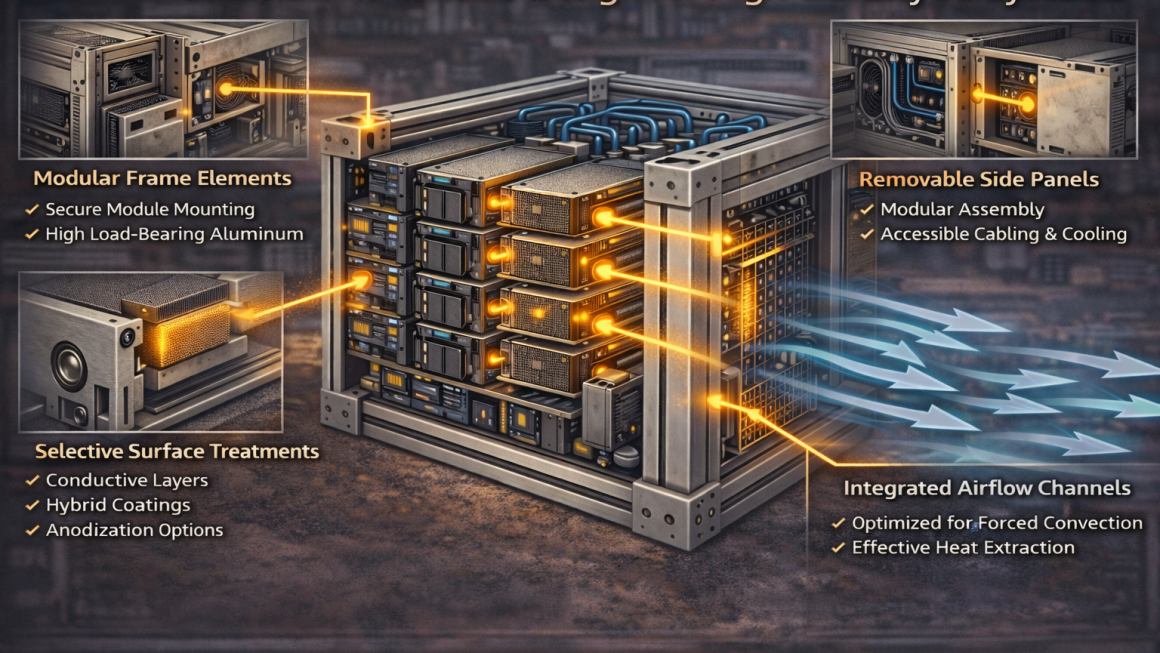
- Machinability and extrusion flexibility: allows complex frame geometries, precise slots, and integrated airflow channels
- Surface treatment options: anodizing, conductive coatings, or hybrid thermal-carbon interfaces
Aluminum chassis provide a predictable and scalable solution where other metals or composites struggle with manufacturability or cost.
2. Core Design Considerations
2.1 Mechanical Stability
High-density AI systems place chassis under stress due to:
- Heavy modular PCBs and GPUs
- Fans and cooling assemblies
- Frequent maintenance or insertion/removal of modules
Key guidelines:
- Reinforce corners and junctions to prevent flexing
- Use extrusions or folded profiles to increase stiffness
- Avoid overly thin walls in load-bearing areas
2.2 Thermal Management
Thermal performance is tightly linked to chassis geometry:
- Integrate heat paths from hot modules to outer frame surfaces
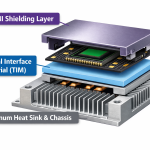
- Use contact pads, thermal interface materials (TIMs), and hybrid carbon coatings where necessary
- Include airflow channels for forced convection
Tip: Simulate thermal flow during early design to identify hotspots.
2.3 Electrical Considerations
Aluminum chassis also function as:
- Grounding planes
- EMI shields
- Contact surfaces for signal stability
Design must ensure electrical continuity where required, and avoid unintended shorting between modules.
3. Optimizing High-Density Layouts
- Vertical stacking: Modules stacked densely require careful airflow and heat extraction
- Horizontal spacing: Maintain enough clearance to prevent thermal interference
- Integrated cable management: Reduces airflow obstruction and mechanical strain
Engineering insight: Every millimeter of aluminum matters—thicker frames conduct heat but may restrict airflow; thinner frames are lighter but can flex under load.
4. Surface Treatments
Surface engineering enhances performance:
- Anodized aluminum: corrosion resistance with moderate thermal impact
- Selective conductive coatings: maintain grounding paths while protecting surfaces
- Hybrid carbon layers: improve thermal spreading at critical hotspots
Note: Surface treatments must align with mechanical and thermal design; a poorly applied coating can increase contact resistance or thermal impedance.
5. Modular Design Philosophy
High-density AI chassis benefit from modularity:
- Standardized frame modules for easy scaling
- Detachable panels for maintenance
- Snap-in or bolted racks to simplify assembly
This approach reduces manufacturing complexity while allowing custom thermal paths and airflow management.
6. Manufacturing and Tolerances
Aluminum allows tight tolerances via CNC machining, extrusion, and bending:
- Ensure interface points (screw holes, slots, module guides) meet design spec
- Maintain flatness and parallelism for thermal contact areas
- Design for repeatable assembly, especially in multi-unit rack systems
Tip: Early prototyping avoids costly rework on complex, high-density chassis.
7. Common Misconceptions
❌ “Aluminum is just a frame—thermal design can be ignored”
→ In high-density AI, the frame is part of the thermal solution.
❌ “Thicker aluminum always improves cooling”
→ Thermal paths depend on continuity and contact, not bulk alone.
❌ “One chassis design fits all AI systems”
→ High-density systems require customized airflow, heat paths, and module support.
8. Practical Guidelines
- Define mechanical load paths before thermal paths.
- Integrate heat dissipation from the earliest design stage.
- Use modular frames to simplify scaling and maintenance.
- Apply surface treatments selectively to balance corrosion protection and electrical conductivity.
- Simulate thermal and airflow performance early to identify bottlenecks.
- Ensure structural and electrical interfaces are clearly documented for manufacturing and assembly.
Designing aluminum chassis for high-density AI systems is an exercise in multi-disciplinary engineering.
Aluminum remains the backbone due to its mechanical and thermal properties, but high-density applications demand:
- Strategic load-bearing geometry
- Integrated heat dissipation paths
- Controlled airflow and module placement
- Selective surface treatments and modularity
The best designs are holistic, addressing mechanical, thermal, and electrical considerations simultaneously.
A well-engineered aluminum chassis not only supports the hardware physically but ensures reliable AI operation under extreme density and continuous use.