
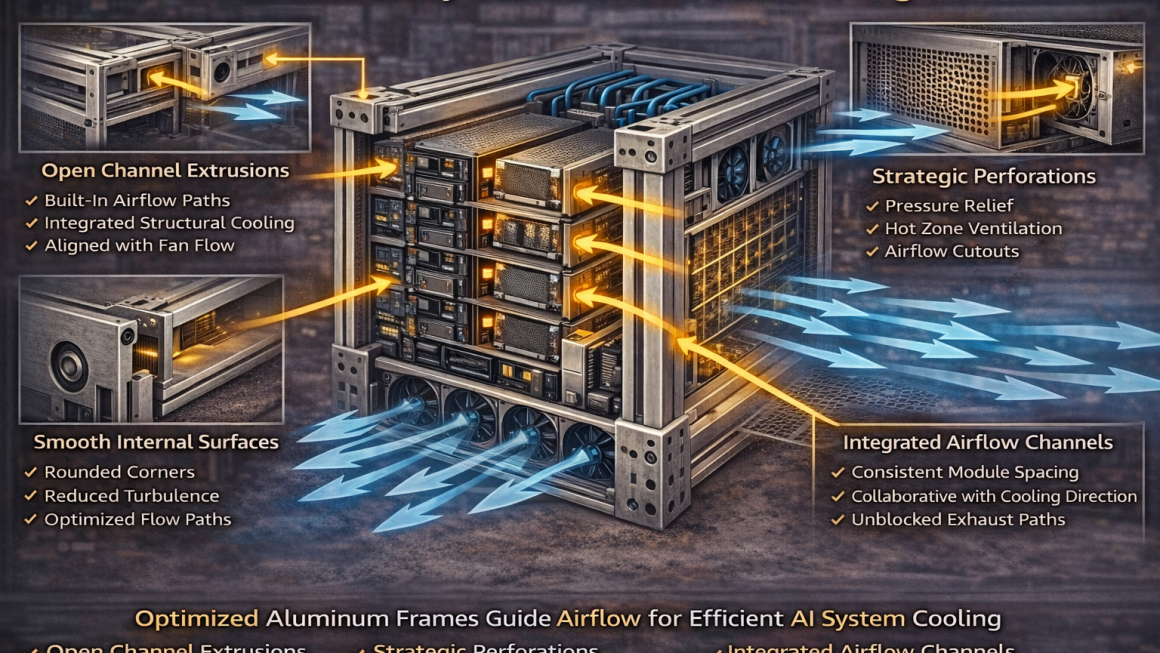
As AI hardware power density continues to rise, cooling challenges are no longer limited to heat sinks and fans. The aluminum structure itself—frames, rails, and chassis—plays a crucial role in shaping airflow behavior.
In high-density AI systems, airflow is not just about moving air through a box. It is about guiding air through tight structural geometries, avoiding turbulence, and ensuring consistent cooling across all modules.
Designing aluminum structures with airflow in mind is now a core engineering discipline rather than a secondary consideration.
1. Why Airflow Must Be Designed Into the Structure
In many systems, airflow problems are mistakenly addressed only after mechanical design is complete. By then, aluminum frames may already block or disrupt air paths.
In high-density AI hardware:
- GPUs and accelerators generate concentrated heat
- Power modules create localized hotspots
- Dense stacking restricts airflow channels
Without airflow-friendly structural design:
- Hot air recirculates
- Cooling becomes uneven
- Fans work harder
- Noise and energy consumption increase
- Component lifetime decreases
The aluminum structure must therefore act as a guide for airflow, not an obstacle.
2. Structural Features That Improve Airflow
2.1 Open Channel Extrusions
Aluminum extrusions can be designed to include:
- Longitudinal airflow channels
- Internal cavities
- Guide rails that double as air paths
These features allow air to travel parallel to structural members, improving cooling efficiency without adding extra components.
2.2 Strategic Perforations and Cutouts
Cutouts in aluminum frames help:
- Reduce pressure buildup
- Prevent stagnant air pockets
- Enable cross-flow cooling
However, they must be placed carefully to avoid weakening load-bearing areas.
Engineering balance:
- Structural strength
- Airflow efficiency
- Manufacturing feasibility
2.3 Smooth Airflow Surfaces
Sharp edges and abrupt geometry changes create turbulence.
Better designs use:
- Rounded internal corners
- Smooth transitions
- Consistent channel widths
Reducing turbulence improves:
- Air velocity consistency
- Heat removal efficiency
- Noise levels
3. Aligning Structure with Cooling Direction
Airflow in AI systems is typically:
- Front-to-back
- Bottom-to-top
- Directed by fan arrays
Aluminum frames should align with this direction.
Poor alignment example:
- Cross-members blocking airflow
- Vertical ribs interrupting fan output
Better design:
- Structural ribs parallel to airflow
- Open corridors between modules
- Clear exhaust paths
When structure and airflow direction match, cooling efficiency improves dramatically.
4. Thermal-Mechanical Integration
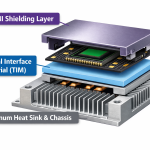
Airflow design cannot be separated from thermal conduction.
Effective systems combine:
- Aluminum heat spreading
- Airflow-guided convection
- Thermal interface materials
Example:
A module transfers heat to an aluminum rail →
rail spreads heat →
airflow removes heat from the rail surface.
If airflow is blocked, the entire thermal chain fails.
5. Fan and Module Spacing
High-density systems require precise spacing:
- Too tight → airflow restriction
- Too loose → wasted volume
Aluminum structures should:
- Maintain consistent gaps between modules
- Support direct airflow paths from fans
- Avoid dead zones behind structural elements
Tip:
Even small spacing adjustments can significantly improve airflow performance.
6. Surface Treatments and Airflow
Surface treatments can influence airflow indirectly:
- Rough coatings increase drag
- Smooth anodized surfaces reduce resistance
- Conductive coatings may affect thermal-air interaction
While the effect is subtle, in high-density systems every improvement matters.
7. Common Mistakes
❌ Designing structure first, airflow later
❌ Blocking fan exhaust paths
❌ Over-reinforcing frames in airflow zones
❌ Ignoring airflow simulation
❌ Assuming fans alone solve cooling
In reality, structure + airflow must be designed together.
8. Practical Engineering Guidelines
- Define airflow direction early
- Align structural members with airflow
- Integrate channels into aluminum extrusions
- Use perforations where structurally safe
- Maintain consistent module spacing
- Validate with airflow simulation
- Prototype and test under real load
9. Future Trends
As AI systems grow denser:
- Liquid cooling increases
- Hybrid air-liquid systems appear
- Structural cooling integration becomes standard
Even in liquid-cooled systems, aluminum structures still guide airflow for auxiliary components.
Airflow-friendly aluminum design will remain essential.
Airflow in AI hardware is no longer just a fan specification—it is a structural design problem.
Aluminum frames must:
- Guide air
- Support modules
- Spread heat
- Maintain rigidity
The most effective designs treat airflow and structure as a single engineering system.
When aluminum structures are designed with airflow in mind, cooling becomes more efficient, systems run quieter, and reliability improves.