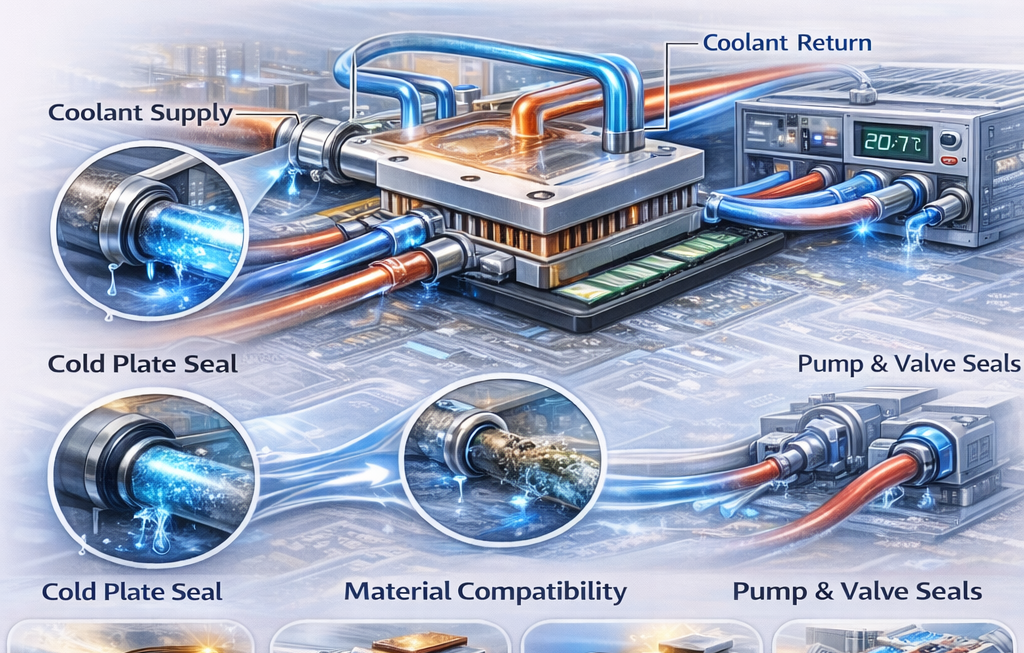
Reliability Is the Real Benchmark
As liquid cooling becomes standard in high-density AI and HPC infrastructure, performance alone is no longer enough.
👉 Reliability—especially leak prevention—has become the true benchmark of system quality.
In modern AI data centers:
- A single coolant leak can damage high-value GPUs
- System downtime directly translates into financial loss
- Maintenance complexity increases with system scale
This means liquid cooling systems must be designed not just for efficiency, but for long-term, failure-resistant operation.
1. Understanding Where Leaks Occur
Leakage does not happen randomly—it typically occurs at interfaces and stress points within the system.
Common leakage locations:
- Tube-to-connector joints
- Cold plate sealing interfaces
- Quick-disconnect couplings
- Pump and valve connections
- O-rings and gasket seals
👉 The more interfaces in a system, the higher the probability of leakage.
This makes system simplification a key design principle.
2. Root Causes of Leakage
Leakage is usually the result of combined mechanical, material, and design factors:
Mechanical Stress
- Thermal expansion and contraction
- Vibration from pumps or system operation
- Improper installation or torque
Material Degradation
- Aging of elastomer seals
- Chemical interaction with coolant
- Corrosion of metallic components
Design Weaknesses
- Poor sealing architecture
- Excessive system pressure
- Incompatible materials in contact
👉 In most real-world cases, leakage is a system-level failure, not a single-component issue.
3. Sealing Technologies: Critical to System Integrity
Elastomer Seals (O-Rings)
- Widely used and cost-effective
- Must be carefully matched with coolant chemistry and temperature range
Metal Seals
- Suitable for high-pressure or mission-critical environments
- Offer higher durability but increased cost and complexity
Bonded and Brazed Interfaces
- Common in cold plate manufacturing
- Require strict process control to avoid micro-leak paths
👉 The choice of sealing technology directly impacts lifetime reliability and maintenance frequency.
4. Material Selection and Compatibility
Material selection is one of the most important factors in leak prevention.
Metals
- Copper: excellent thermal performance but requires corrosion control
- Aluminum: lightweight and scalable, but sensitive to coolant chemistry
- Stainless steel: highly resistant but more expensive
Polymers and Tubing
- Must resist:
- Permeation
- Swelling
- Chemical degradation
Surface Engineering
- Anodization for aluminum
- Anti-corrosion coatings
- Barrier layers to reduce leakage risk
👉 Compatibility between coolant and materials is essential to prevent long-term degradation.
5. Design Strategies for Leak Prevention
Reduce System Complexity
- Minimize joints and connection points
- Integrate components where possible
Optimize Pressure and Flow
- Avoid excessive pressure in microchannels
- Balance flow rate with system stability
Adopt Modular Architecture
- Controlled, standardized interfaces
- Easier maintenance and replacement
Implement Monitoring Systems
- Leak detection sensors
- Pressure and flow monitoring
- Automated shutdown mechanisms
👉 Reliable systems are designed with fail-safe mechanisms, not just ideal conditions.
6. Testing and Validation
Before deployment, liquid cooling systems must undergo rigorous validation:
- Pressure and leak testing
- Thermal cycling tests
- Long-term durability testing
- Coolant compatibility verification
These tests ensure the system can operate continuously under high load conditions, as required in AI infrastructure.
7. Why Reliability Matters in AI Infrastructure
In AI and HPC environments:
- Systems operate 24/7 under high thermal load
- Hardware costs are extremely high
- Downtime has significant operational impact
A reliable liquid cooling system must deliver:
- Stable, leak-free operation
- Predictable long-term performance
- Minimal maintenance intervention
Reliability Is Designed, Not Added Later
Leak prevention is not a single feature—it is the result of:
- Careful material selection
- Robust sealing design
- Optimized system architecture
- Continuous monitoring and validation
👉 In next-generation AI infrastructure, the most competitive solutions are those that integrate thermal performance with engineering reliability from the ground up.