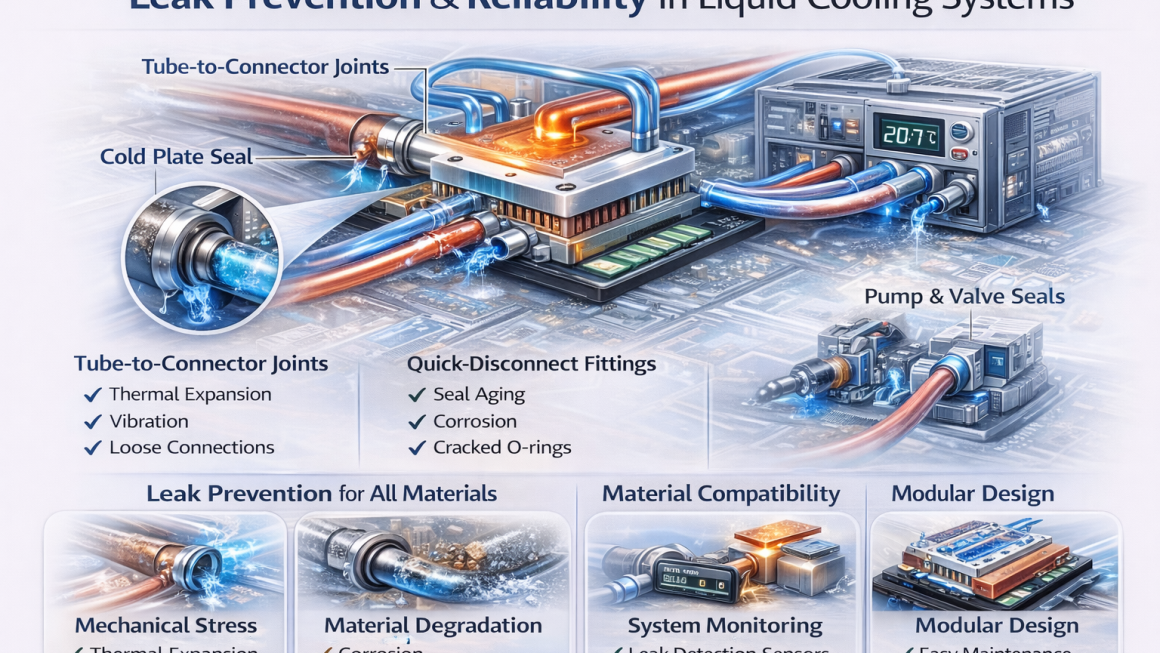
Why Reliability Matters More Than Performance
As liquid cooling becomes the standard for high-density AI infrastructure, system performance is no longer the only concern.
👉 Reliability and leak prevention are now critical success factors
In large-scale AI data centers:
- A single leak can damage high-value GPUs
- Downtime costs can reach thousands per minute
- Maintenance complexity increases with system scale
This makes leak prevention not just a design feature—but a core engineering requirement.
1. Where Do Leaks Occur in Liquid Cooling Systems?


7
Leak risks are typically concentrated in connection and interface points:
Common leak locations:
- Tube-to-connector joints
- Cold plate interfaces
- Quick-disconnect fittings
- Pump and valve connections
- Sealing components (O-rings, gaskets)
👉 The more complex the system, the more potential failure points.
2. Root Causes of Leakage
Mechanical Stress
- Thermal expansion and contraction
- Vibration from pumps or airflow
- Improper installation or torque
Material Degradation
- Seal aging (O-rings, elastomers)
- Coolant-induced corrosion
- Polymer swelling or cracking
Design Limitations
- Poor sealing design
- Excessive pressure in microchannels
- Incompatible materials in contact
👉 Leakage is rarely caused by a single factor—it is usually a system-level failure.
3. Sealing Technologies: The First Line of Defense
O-Rings and Elastomer Seals
- Most widely used sealing method
- Must match coolant chemistry and temperature range
Metal Seals
- Higher reliability in extreme environments
- Used in high-pressure or mission-critical systems
Adhesive & Bonded Seals
- Common in cold plate manufacturing
- Requires strict process control
👉 Seal selection must consider:
- Temperature range
- Coolant type
- Pressure conditions
- Lifetime requirements
4. Material Selection for Leak Prevention
Material choice plays a direct role in system reliability:
Metals (Copper / Aluminum / Stainless Steel)
- Must resist corrosion and fatigue
- Surface treatment is critical
Polymers and Tubing
- Must resist:
- Permeation
- Chemical degradation
- Mechanical stress
Coatings and Surface Engineering
- Anti-corrosion coatings
- Improved wettability
- Reduced micro-leak paths
👉 Advanced materials (including graphene-based coatings) can enhance:
- Barrier properties
- Structural stability
- Long-term durability
5. System Design Strategies for Reliability
Minimize Connection Points
- Fewer joints = fewer leak risks
Modular Design
- Easier maintenance and replacement
- Controlled interfaces
Pressure Optimization
- Avoid excessive pressure in microchannels
- Balance flow vs reliability
Redundancy and Monitoring
- Leak detection sensors
- Pressure and flow monitoring
- Automatic shutdown systems
6. Testing and Validation
Before deployment, systems must undergo:
- Pressure testing (leak test)
- Thermal cycling tests
- Long-term reliability testing
- Material compatibility validation
👉 This is especially critical in AI infrastructure where systems operate 24/7 under high load.
7. Why This Matters for AI Data Centers
In AI environments:
- Hardware cost is extremely high
- Downtime has major financial impact
- Maintenance windows are limited
A well-designed liquid cooling system must deliver:
- Zero-leak operation
- Long service life
- Predictable performance
Reliability Is Designed, Not Assumed
Leak prevention is not a single component issue—it is the result of:
- Material selection
- Mechanical design
- Thermal management
- System integration
👉 The most successful liquid cooling solutions are those that treat reliability as a core design principle, not an afterthought.