


Why Thermal Interface Materials (TIMs) Matter More Than You Think in AI Infrastructure
The Invisible Bottleneck in AI Systems
As artificial intelligence workloads continue to scale—from large language models to real-time inference—the demand for high-performance computing infrastructure has surged dramatically. Much of the industry focus has been placed on processors, GPUs, and advanced cooling systems such as liquid cooling. However, there is a critical yet often overlooked layer that directly impacts system performance and reliability: thermal interfaces.
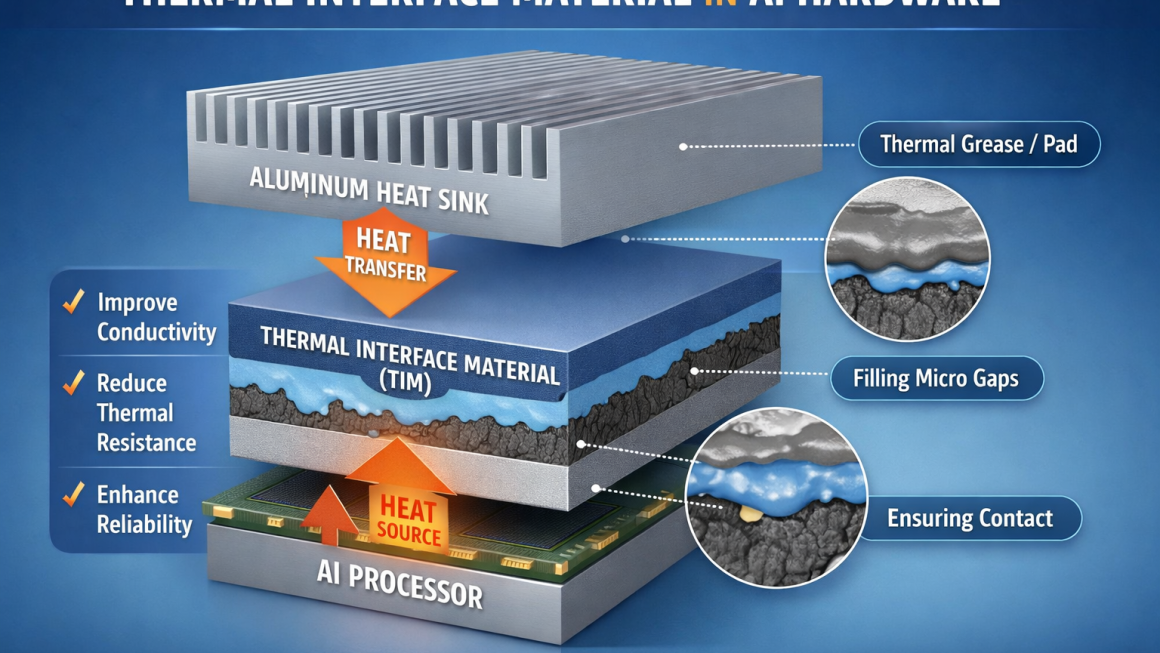
Thermal Interface Materials (TIMs) sit between heat-generating components and heat dissipation structures. They are not visible in system diagrams, nor are they often highlighted in marketing materials. Yet, they can determine whether a system runs efficiently—or fails prematurely.
For platforms like aluminum4ai.com, which focus on engineering collaboration rather than mass production, understanding this “hidden layer” is essential to enabling better system-level design.
What Are Thermal Interfaces?
In any AI server or data center hardware, heat must travel from the source (e.g., GPU die) to the cooling solution (heat sink, cold plate, or liquid loop). However, surfaces are never perfectly smooth. Microscopic air gaps exist between them—and air is a poor thermal conductor.
This is where TIMs come in.
Thermal Interface Materials fill these gaps, reducing thermal resistance and improving heat transfer efficiency.
Common Types of TIMs
- Thermal greases (pastes)
- Gap fillers (pads)
- Phase change materials (PCMs)
- Adhesives (thermally conductive bonding materials)
- Advanced carbon-based films (graphene, graphite)
Each type serves a different purpose depending on mechanical constraints, thermal requirements, and manufacturing considerations.
Why TIMs Matter More in AI Hardware
AI systems generate significantly more heat than traditional computing systems. High-performance GPUs and accelerators can exceed 500–1000W per module, creating extreme thermal challenges.
1. Increasing Power Density
Modern AI chips pack more transistors into smaller areas. This leads to:
- Higher heat flux (W/cm²)
- Localized hotspots
- Increased thermal gradients
TIM performance directly affects how efficiently this heat is removed.
2. Sensitivity to Thermal Resistance
Even a small increase in thermal resistance at the interface can result in:
- Higher junction temperatures
- Reduced performance (thermal throttling)
- Shortened component lifespan
In high-density AI clusters, this effect multiplies across thousands of nodes.
3. Compatibility with Advanced Cooling Systems
AI infrastructure is rapidly shifting toward:
- Liquid cooling
- Direct-to-chip cold plates
- Immersion cooling
Each of these systems places new demands on TIMs, such as:
- Mechanical compliance
- Pump-out resistance
- Long-term stability under cycling
The Role of Aluminum in Thermal Interface Design
While TIMs are often discussed independently, their performance is tightly linked to the materials they interface with—especially aluminum.
Aluminum remains a dominant material in AI hardware due to:
- High thermal conductivity
- Lightweight structure
- Cost-effectiveness
- Manufacturability
Interaction Between Aluminum and TIMs
The effectiveness of a TIM depends on:
- Surface roughness of aluminum components
- Flatness and tolerances
- Contact pressure distribution
Poorly designed aluminum surfaces can:
- Increase interface thickness
- Trap air pockets
- Reduce effective conductivity
This is why thermal interface design cannot be separated from structural material engineering.
The Engineering Challenge: Not Just a Material Problem
One of the biggest misconceptions is that TIM performance is purely a material property. In reality, it is a system-level engineering problem.
Key Design Variables
- Surface Topography
- Machining quality of aluminum heat sinks or cold plates
- Micro-scale roughness affects contact quality
- Contact Pressure
- Mounting force influences TIM thickness and performance
- Thermal Cycling
- Expansion mismatch between materials
- Leads to degradation over time
- Assembly Process
- Manual vs automated dispensing
- Thickness control consistency
Why “Advanced Materials” Alone Are Not Enough
Graphene-enhanced TIMs and other advanced materials are often marketed as breakthrough solutions. While they offer potential improvements in thermal conductivity, they do not automatically solve interface challenges.
Limitations of Material-Centric Thinking
- High conductivity does not guarantee system performance
- Poor interface contact can negate material advantages
- Integration complexity increases with new materials
For many AI hardware applications, engineering integration matters more than peak material performance.
Aluminum4AI Approach: Supporting R&D, Not Mass Claims
At aluminum4ai.com, the focus is not on claiming mass production of next-generation materials. Instead, the approach is:
1. Supporting Early-Stage Development
- Prototype-level thermal interface exploration
- Material compatibility testing
- Small-scale validation
2. System-Level Thinking
Rather than isolating TIMs, the focus is on:
- Aluminum component design
- Interface optimization
- Integration with cooling architecture
3. Bridging Materials and Application
Many suppliers operate at either:
- Raw material level
- Finished product level
But there is a gap in between—where:
- Materials must be adapted
- Interfaces must be engineered
- Systems must be validated
This is where collaboration becomes critical.
Common Failure Modes in Thermal Interfaces
Understanding failure modes helps guide better design decisions.
1. Pump-Out Effect
Thermal cycling causes TIMs (especially greases) to migrate away from the interface.
Result:
- Increased thermal resistance
- Performance degradation over time
2. Dry-Out
Volatile components evaporate under high temperature.
Result:
- Hardening of TIM
- Loss of contact efficiency
3. Mechanical Fatigue
Repeated expansion and contraction lead to:
- Cracking
- Delamination
4. Surface Mismatch
Poor flatness or uneven pressure leads to:
- Incomplete contact
- Air gap formation
Design Considerations for AI Hardware Engineers
To optimize thermal interfaces in AI systems, engineers should consider:
Material Selection
- Match TIM type to application
- Balance conductivity and reliability
Surface Engineering
- Improve aluminum surface finish
- Control flatness and tolerances
Assembly Control
- Ensure consistent application thickness
- Optimize mounting pressure
Testing and Validation
- Thermal cycling tests
- Long-term reliability evaluation
- Real-world workload simulation
The Future of Thermal Interfaces in AI
As AI infrastructure evolves, thermal interface design will become even more critical.
Emerging Trends
- Ultra-high power chips (>1000W)
- Hybrid cooling systems
- Advanced packaging (chiplets, 3D stacking)
These trends will require:
- More adaptable TIM solutions
- Better integration with structural materials
- Closer collaboration between material suppliers and system designers
The Hidden Layer That Defines Performance
Thermal interfaces may not be visible, but they are fundamental to AI hardware performance. They sit at the intersection of materials science, mechanical engineering, and system design.
For companies like aluminum4ai.com, the opportunity is not in claiming breakthrough materials—but in enabling:
- Better integration
- Smarter design
- More reliable systems
In the rapidly evolving AI hardware landscape, the “hidden layer” is no longer optional. It is a defining factor in whether systems scale efficiently—or fail silently.