
Introduction: Why Material Choice Matters in AI Servers
In modern high-density AI servers, GPUs often exceed 1000W power consumption. Choosing the right thermal management material directly impacts server stability, performance, and lifespan. Aluminum and copper are the most commonly used materials, but they differ significantly in thermal performance, cost, and manufacturability. This article compares aluminum and copper from the perspective of thermal conductivity, weight, cost, and structural integration in AI server designs.
1️⃣ Thermal Conductivity and High-Power GPUs
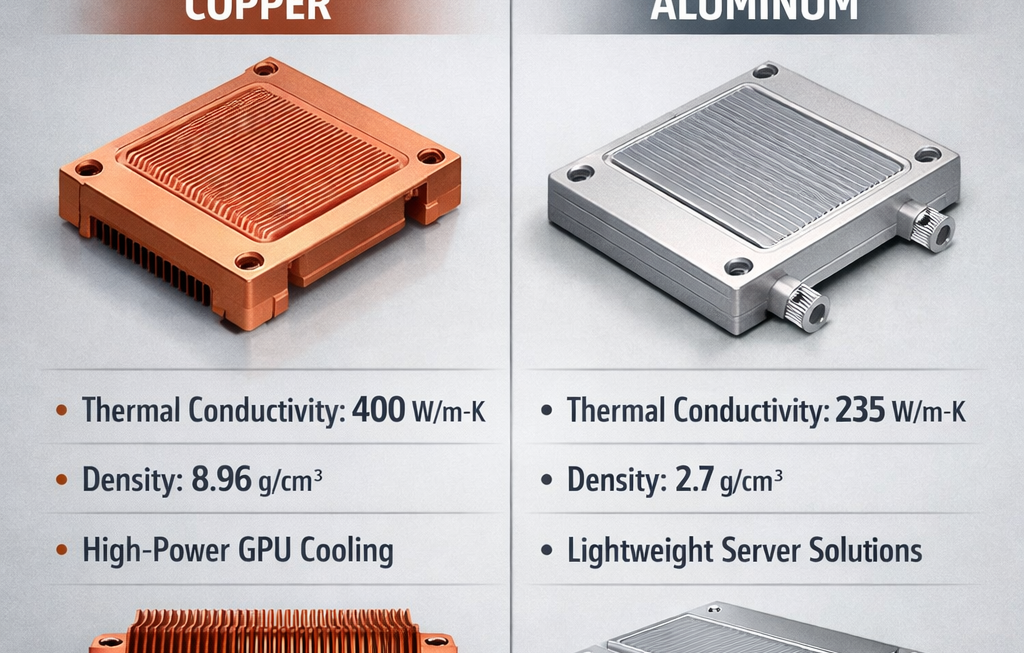
- Copper: High thermal conductivity (~400 W/m·K) enables rapid heat removal, making it ideal for ultra-high-power GPU cooling.
- Aluminum: Moderate thermal conductivity (~235 W/m·K) is sufficient for most mid-range servers and can be optimized with design enhancements.
- SEO Tip: Naturally include terms like “GPU thermal cooling” and “AI server heat management” in the text.
2️⃣ Weight and Structural Considerations
- Copper density is high (8.96 g/cm³), which can add significant weight to large GPU racks and may require reinforced chassis designs.
- Aluminum is lightweight (2.7 g/cm³), supporting high-density AI clusters and easier transport and installation.
- Material choice affects not only thermal performance but also mechanical design and operational cost in data centers.
3️⃣ Cost and Manufacturability
- Copper is more expensive and harder to machine but offers superior thermal performance, making it suitable for high-end servers or critical liquid cooling paths.
- Aluminum is cost-effective and easier to process, allowing large-scale production of AI servers. Thermal efficiency can be improved with microchannel designs, surface treatments, or composite coatings.
4️⃣ Real-World Applications
- Aluminum cold plates are increasingly common in GPU cooling, especially in liquid-cooled setups, using optimized microchannel structures to enhance heat transfer.
- Copper heat sinks or cold plates dominate ultra-high-power AI accelerators requiring 24/7 continuous operation, particularly in critical thermal paths.
5️⃣ Making the Right Material Decision
Choosing between aluminum and copper requires balancing:
- GPU power density
- Rack density and weight constraints
- Data center operational cost and budget
- System reliability and lifespan
For most AI servers, optimized aluminum structures provide a balance of cost, weight, and cooling performance, while copper remains the top choice for high-power critical components.